
Workarounds in Electronic Health Record Systems: Usability, Nursing Practice, and Workflow Implications – A Synthesis of Recent Evidence and Recommendations for Healthcare Organizations

by Dr. Noha Saleh O. S. Ahmed 1 PhD, MSN, PGDCA ,
Dr. Wahg Al Mashaer El Hag1 PhD, MBA, BS-IT
1 Nursing Informatics Specialist Nursing informatics department,
Hamad Medical Corporation, Doha, Qatar.
Citation: Ahmed, N. S. O. S.., & El Hag, W. A. M. (2026). Workarounds in electronic health record systems: Usability, nursing practice, and workflow implications – A synthesis of recent evidence and recommendations for healthcare organizations. Canadian Journal of Nursing Informatics, 21(3). https://cjni.net/journal/?p=17374
Abstract
The adoption of electronic health records (EHRs) has brought substantial changes to healthcare delivery, improving access to information and supporting clinical decision-making. At the same time, differences between how these systems are designed and how care is delivered in practice have led healthcare professionals to develop workaround practices. This narrative review brings together evidence published between 2011 and 2023 to examine the nature of these practices, their underlying causes, and their implications for workflow efficiency and patient safety, with particular attention to nursing practice.
A structured search was conducted across PubMed, CINAHL, Scopus, and Google Scholar. A transparent screening process, informed by PRISMA principles, resulted in the inclusion of 17 studies. The selected studies were analyzed thematically to identify consistent patterns across varied clinical settings and research designs. The findings show that workaround behaviours arise from a combination of interacting factors rather than a single cause. These include mismatches between workflow and system processes, usability limitations, and human factors such as workload and training gaps. Although such practices may help clinicians manage immediate demands and maintain continuity of care, they can also introduce inconsistencies in documentation, increase cognitive demands, and create risks for patient safety, particularly through communication gaps and incomplete records.
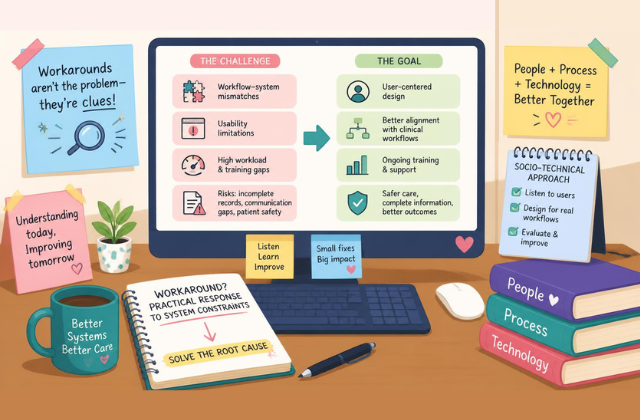
Rather than viewing workarounds solely as deviations from expected system use, they can be understood as practical responses to system constraints that also signal underlying inefficiencies. Addressing these issues requires a socio-technical approach that combines user-centered system design, better alignment with clinical workflows, and ongoing evaluation.
Keywords: electronic health records, workarounds, workflow efficiency, patient safety, nursing informatics, usability
Background
The introduction of electronic health records (EHRs) has changed the way clinical information is accessed, shared, and used in healthcare settings. These systems have contributed to improved communication, more structured documentation, and greater support for evidence-informed decision-making. However, alongside these benefits, challenges related to usability and workflow integration continue to influence how EHRs are used in everyday clinical practice (Carayon et al., 2015; Zheng et al., 2020).
In many healthcare environments, there is still a noticeable disconnect between how EHR systems are designed and how care is actually delivered. Clinicians often need to adjust their practices to meet both patient care needs and system requirements. One common response to this situation is the use of workaround practices—informal strategies that allow clinicians to complete tasks when systems do not fully support their workflow. These practices are often practical and goal-oriented, reflecting attempts to balance system constraints with clinical priorities (Debono et al., 2013; Bianchi & Ghirotto, 2022). At the same time, their growing use raises concerns about data consistency, adherence to standards, and patient safety.
Research has identified a range of factors that contribute to the development of workaround behaviours. These include system-related issues such as limited usability, high documentation burden, lack of interoperability, and insufficient customization for specific clinical contexts (Blijleven et al., 2017; Persson & Rydenfält, 2021). In addition, human factors, such as workload pressures, familiarity with systems, and adequacy of training play a significant role in shaping how clinicians interact with EHRs (Lopez et al., 2021; McCord et al., 2022). These influences are interconnected, and together they create conditions in which workaround practices become part of routine clinical activity.
From a workflow perspective, workarounds are often used to manage time constraints and maintain continuity of care. Clinicians may rely on alternative approaches such as parallel documentation, informal communication, or modified data entry practices to complete tasks more efficiently (Fraczkowski et al., 2020; Lee & Lee, 2021). While these strategies may provide short-term relief, they can also lead to inconsistencies in documentation and disrupt standardized processes. Evidence suggests that ongoing documentation burden and fragmented workflows continue to drive the use of such practices, particularly in high-pressure clinical environments (Moy et al., 2023; Holmes et al., 2021).
The implications for patient safety are equally important. When system safeguards are bypassed, even with the intention of improving efficiency, the risk of errors may increase. Incomplete documentation, communication gaps, and reduced data reliability can affect clinical decision-making and care outcomes (Boonstra et al., 2021; Beerepoot et al., 2021). Although some studies note that workarounds may help avoid immediate delays in care, concerns remain about their longer-term impact on safety and quality (Zheng et al., 2020; Blijleven et al., 2022).
The literature also highlights the dual nature of workaround behaviours. On one side, they can be seen as adaptive responses that help clinicians navigate system limitations and maintain care delivery. On the other, their continued use may normalize deviations from established procedures and weaken standardization efforts. This tension between efficiency and safety is widely acknowledged but not always explored in an integrated way.
Although there is extensive research on EHR usability, workflow challenges, and patient safety, these areas are often examined separately. There is comparatively less work that brings them together to provide a combined understanding of how workaround behaviours influence both workflow performance and patient safety, particularly in nursing practice, where interaction with EHR systems is continuous and central to care delivery (Tolentino & Gephart, 2021; Gephart et al., 2015).
This review addresses that gap by examining workaround behaviours from an integrated perspective. It focuses on their underlying causes, how they manifest in practice, and their implications for both workflow and patient safety. By drawing together findings from diverse studies, the review aims to provide a more comprehensive understanding of how these practices emerge and how they can be addressed through system design improvements, workflow alignment, and targeted training strategies.
Overall, EHR workarounds should be understood not simply as technical issues, but as outcomes of the interaction between system design, clinical workflows, and human factors. Addressing them effectively requires coordinated efforts that combine technological improvements with organizational and practice-level changes, with patient safety remaining a central priority.
Methodology
Review Design
This study uses a narrative review approach to examine electronic health record (EHR) workaround behaviours. This design was selected because the available literature is diverse, including qualitative, quantitative, mixed-methods, and review studies. Rather than restricting the analysis to a single type of evidence, the narrative approach allows for a broader and more flexible synthesis.
This is particularly important when exploring workaround behaviours, which involve interactions between system design, clinical workflows, and human factors. A narrative framework supports a more context-sensitive understanding of these interactions, making it suitable for examining a complex socio-technical issue.
Search Strategy
A structured search was carried out across multiple databases, including PubMed, CINAHL, Scopus, and Google Scholar, to capture relevant studies from clinical, nursing, and health informatics fields.
The search combined both controlled vocabulary and free-text terms to ensure comprehensive coverage. Key terms included variations of “electronic health records,” “EHR,” “workarounds,” “workflow deviations,” “clinical workflow,” “usability,” “system design,” and “patient safety.” Boolean operators (AND/OR) were used to refine the search and combine concepts effectively.
To maintain relevance to current clinical practice, the search was limited to peer-reviewed studies published between 2011 and 2023, reflecting the period during which EHR systems became widely adopted in healthcare settings.
Inclusion and Exclusion Criteria
Studies were selected based on predefined criteria to ensure relevance and consistency.
Inclusion criteria:
- Peer-reviewed publications between 2011 and 2023
- Studies examining EHR workaround behaviours in clinical settings
- Research involving healthcare professionals, with a particular focus on nurses
- Studies addressing workflow, usability, or patient safety
- Quantitative, qualitative, mixed-methods, and review designs
Exclusion criteria:
- Non-English publications
- Editorials, opinion papers, or commentaries without empirical data
- Studies not directly related to EHR systems or workaround behaviours
- Research focused solely on technical system development without clinical application
Screening and Selection Process
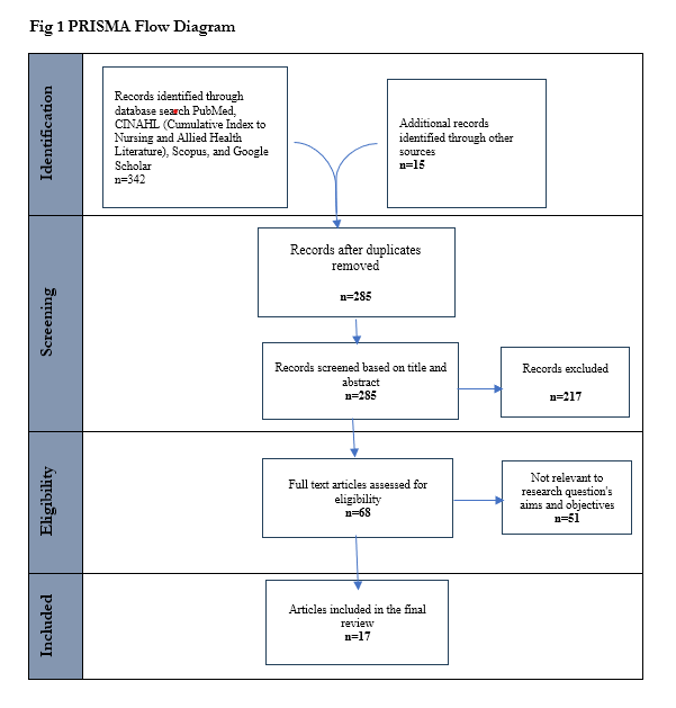
The selection process was carried out in stages to ensure transparency and consistency. An initial set of 357 records was identified through database searches and additional sources. After removing duplicates, 285 records remained for screening.
Titles and abstracts were reviewed to assess relevance, resulting in the exclusion of 217 studies that did not meet the inclusion criteria. The remaining 68 articles were reviewed in full. Of these, 51 were excluded due to lack of relevance to workaround behaviours, absence of clinical or workflow context, non-empirical content, or insufficient reporting.
A final set of 17 studies met the inclusion criteria and were included in the synthesis. While the process was informed by PRISMA principles to enhance transparency, it was applied in a manner appropriate for a narrative review rather than a formal systematic review.
Data Synthesis
The included studies were analyzed using a thematic approach, concentrating on identifying patterns related to various aspects. Specifically, the analysis focused on types of workaround behaviours, contributing factors such as workflow, system design, and human elements, and the reported impacts of these behaviours on efficiency, safety, and data quality. Findings were grouped into key themes to facilitate structured interpretation, and a summary table (Table 1) was created to present study characteristics and main findings in a consistent manner, enabling easier comparison across studies. Throughout the synthesis process, particular attention was paid to the clarity and relevance of each study, ensuring that the analysis remained both focused and meaningful.
Table 1
Summary of Included Studies on EHR Workarounds and Their Impact on Workflow and Patient Safety
Results and Discussion
This section synthesizes findings from the included studies to examine electronic health record (EHR) workaround behaviours, with particular attention to nursing practice, workflow efficiency, and patient safety. Given the diversity of study designs, an interpretive and thematic approach was used to identify recurring patterns and relationships across different clinical contexts.
A total of 17 studies published between 2011 and 2023 were included. Together, they illustrate that workaround behaviours are not isolated events but are embedded within routine clinical practice. These behaviours appear across a range of activities, including documentation, medication administration, communication, and data management, reflecting how clinicians adapt systems used to meet practical demands.
PRISMA Summary (Text Representation)
Identification
- Records identified through database searching: 342
- Additional records identified through other sources: 15
- Total records identified: 357
Screening
- Records after duplicates removed: 285
- Records screened (title/abstract): 285
- Records excluded: 217
Eligibility
- Full-text articles assessed: 68
- Full-text articles excluded: 51
- Not related to EHR workarounds: 20
- No clinical/workflow relevance: 15
- Non-empirical or opinion-based: 10
- Insufficient data: 6
Included
- Studies included in qualitative synthesis: 17
Figure 1
PRISMA Flow Diagram
Nature and Forms of Workaround Behaviours
Through the reviewed studies, workaround practices can be broadly understood as either internal (within the EHR system) or external (outside the system). Internal practices include actions such as bypassing alerts, modifying data entry, using copy-paste functions, or leaving required fields incomplete (Blijleven et al., 2017; McCord et al., 2022). External practices involve the use of paper notes, parallel documentation systems, or reliance on verbal communication in place of electronic records (Debono et al., 2013; Beerepoot et al., 2021).
Rather than representing simple deviations, these behaviours reflect attempts to align system use with clinical realities. Their consistent presence across studies suggests that they are closely tied to how systems function in practice. In this sense, workaround behaviours can be seen as practical adjustments that emerge when system processes do not fully support clinical workflows.
Drivers of Workaround Behaviours
The findings indicate that workaround practices are shaped by a combination of interacting factors rather than a single cause. Three main influences emerge consistently: workflow misalignment, system design limitations, and human factors.
Workflow-related challenges occur when EHR processes do not match the sequence or pace of clinical care (Zheng et al., 2020). System-related issues, including complex interfaces, limited flexibility, and poor interoperability further complicate system use (Persson & Rydenfält, 2021). At the same time, human factors such as workload, cognitive demands, and training gaps influence how clinicians respond to these challenges (Lopez et al., 2021; McCord et al., 2022).
These factors do not operate independently. Instead, they interact within the clinical environment, shaping how clinicians engage with EHR systems. Evidence suggests that workaround behaviours tend to emerge at points where these pressures converge, reinforcing the idea that they are rooted in broader socio-technical conditions rather than individual choices.
Implications for Workflow Efficiency
From a workflow perspective, workaround behaviours present a mixed picture. In the short term, they often help clinicians manage time constraints, complete tasks, and maintain continuity of care, particularly in high-demand settings (Bianchi & Ghirotto, 2022; Fraczkowski et al., 2020). These adaptations can reduce immediate delays and allow clinical work to proceed despite system limitations.
However, the longer-term effects are less favorable. Repeated reliance on workaround practices can lead to duplication of effort, fragmented processes, and increased cognitive load. Studies also suggest that system-related tasks frequently extend beyond standard working hours, indicating that inefficiencies are not resolved but redistributed (Johnson et al., 2025). In this way, workaround behaviors may temporarily support workflow performance while simultaneously masking underlying structural issues.
Implications for Patient Safety and Data Quality
The impact of workaround behaviours on patient safety is a central concern across the literature. While these practices may facilitate care delivery in the moment, they can introduce risks that affect both immediate and downstream outcomes.
Direct risks arise when system safeguards, such as alerts, verification steps, or decision-support functions—are bypassed, increasing the likelihood of errors (Boonstra et al., 2021; Beerepoot et al., 2021). Indirect risks are associated with incomplete or inconsistent documentation, breakdowns, and reduced data reliability. These issues may not always be apparent at the point of care but can accumulate overtime, affecting clinical decision-making and patient outcomes.
Recent evidence linking usability challenges to diagnostic delays and adverse events further highlights the importance of system design in supporting safe practice (Singh et al., 2024). Together, these findings suggest that workaround behaviours are closely tied to the conditions under which care is delivered, rather than being isolated by safety concerns.
Implications for Nursing Practice
The effects of workaround behaviours are particularly evident in nursing practice, where clinicians interact continuously with EHR systems as part of patient care. Nurses often adopt workaround strategies to manage competing demands, maintain workflow continuity, and respond to time pressures (Bianchi & Ghirotto, 2022; Fraczkowski et al., 2020).
At the same time, these adaptations may affect documentation accuracy, consistency, and adherence to established protocols. Workaround use appears to be more pronounced in complex clinical environments, such as tertiary care settings, where workflow demands are high (Lee & Lee, 2021). Usability challenges and interface design also play a significant role in shaping how nurses interact with systems and when workaround practices are adopted (Tolentino & Gephart, 2021).
These findings highlight the importance of designing systems that align with nursing workflows and support practical clinical needs.
Integrated Interpretation
When considered together, the findings point to a consistent pattern: workaround behaviours serve both functional and problematic roles within clinical practice. On one hand, they enable clinicians to continue delivering care under constrained conditions. On the other, they introduce variability, reduce standardization, and may compromise safety and data quality.
This dual role reflects an underlying tension between efficiency and safety. Efforts to improve workflow performance through informal adaptations may unintentionally increase risk, particularly when system safeguards are bypassed or documentation practices become inconsistent.
An important insight from this review is that workflow inefficiencies and patient safety risks are closely linked. Increased cognitive load, often associated with poor usability and fragmented workflows creates conditions where errors are more likely to occur (Ratwani et al., 2025). This suggests that interventions targeting only one dimension are unlikely to be sufficient.
From an organizational perspective, the persistence of workaround behaviours indicates that current approaches to EHR implementation may not fully address clinical realities. Systems that are introduced without adequate alignment to workflows often require users to adapt in ways that were not originally intended.
The findings support a shift toward more user-centered and workflow-oriented approaches, where systems are continuously refined based on real-world use and clinician feedback (Middleton et al., 2025). Engaging frontline users, particularly nurses, in system design and evaluation is essential to ensure that digital solutions are both usable and effective.
Overall, workaround behaviours can be understood as practical signals of system–workflow misalignment. Recognizing them in this way provides a constructive basis for identifying system gaps and guiding improvement efforts.
Limitations
This review uses a narrative approach, which allows for a flexible and context-sensitive exploration of a complex topic. While this approach supports a broader understanding of workaround behaviours, it does not include formal statistical synthesis methods such as meta-analysis or standardized quality appraisal. As a result, the findings are interpretive rather than statistically generalizable.
The inclusion of studies with varied designs and settings introduces differences in methodology, context, and reporting. Although this limits direct comparability, it also provides a wider view of how workaround behaviours occur across different clinical environments.
The review is limited to English-language studies published between 2011 and 2023. This timeframe reflects the period of widespread EHR adoption and ensures relevance to current practice, although some relevant studies outside these criteria may not have been included.
Despite these limitations, methodological transparency was maintained through a structured search process, clearly defined inclusion criteria, and systematic thematic synthesis. Future research using more standardized or mixed-method approaches may help to further strengthen and quantify these findings.
Conclusion
This review synthesizes current evidence on electronic health record (EHR) workaround behaviours and highlights their significance within modern healthcare systems. By examining their types, underlying drivers, and impacts, the study offers an interpretive synthesis of these practices as part of everyday clinical work rather than as isolated irregularities.
A key contribution of this review is its integrated perspective, linking workflow performance with patient safety. These areas are often studied separately, yet the findings presented here suggest that they are closely interconnected. This perspective provides a conceptual understanding of how workaround behaviours influence both workflow processes and safety outcomes in clinical settings.
The findings support the interpretation of workaround behaviours as indicators of gaps between system design and clinical practice. Addressing these gaps requires approaches that focus on usability, workflow alignment, and active involvement of clinicians in system development and improvement. Without such efforts, workaround practices are likely to persist, with potential implications for both efficiency and patient safety as healthcare systems continue to evolve.
Recommendations
Addressing workaround behaviours in EHR use requires a coordinated approach that considers system design, clinical workflows, and user experience together. Improving usability should be a priority, with attention to simplifying interfaces, reducing unnecessary documentation requirements, and ensuring that systems reflect the realities of clinical practice.
Regular evaluation of workflows is also essential. Identifying where system processes do not align with clinical needs can support targeted redesign efforts that reduce reliance on workaround practices. This process should involve collaboration between clinicians, informatics teams, and system developers to ensure that solutions are both practical and sustainable. Ongoing training plays an important role in supporting effective system use. Educational initiatives should be tailored to specific roles and focus on practical application within clinical settings. As systems evolve, continuous professional development is needed to maintain competence and confidence among users.
Organizations should also make use of available data to monitor system use and identify patterns of workaround behaviour. System logs, user feedback, and performance data can provide valuable insights into where challenges exist and how they might be addressed. Finally, involving frontline clinicians, particularly nurses in system design, implementation, and evaluation is critical. Their direct experience with EHR systems positions them to identify practical challenges and contribute to meaningful improvements. Future research should continue to explore effective interventions and consider how emerging analytical tools can support early identification and mitigation of workaround behaviours.
References
Alharthi, H., Alassaf, M., & Alshammari, F. (2025). Work system factors influencing electronic health record workaround behaviors in clinical environments. International Journal of Medical Informatics, 185, 105432. https://doi.org/10.1016/j.ijmedinf.2025.105432
Beerepoot, I., Lu, X., van de Weerd, I., & Reijers, H. A. (2021). Detecting and analyzing workarounds in electronic health record systems: A process mining approach. BMC Medical Informatics and Decision Making, 21, 287. https://doi.org/10.1186/s12911-021-01663-4
Benda, N. C., Meadors, M. L., & Hettinger, A. Z. (2024). Electronic health record usability, clinician burden, and burnout: A human factors analysis. Applied Clinical Informatics, 15(1), 45–56. https://doi.org/10.1055/s-0043-1771234
Bianchi, M., & Ghirotto, L. (2022). Nurses’ perspectives on workarounds in clinical practice: A phenomenological analysis. Journal of Clinical Nursing, 31(19–20), 2850–2859. https://doi.org/10.1111/jocn.16123
Blijleven, V., Koelemeijer, K., Jaspers, M., & Willems, D. (2022). Workarounds in electronic health record systems and the Sociotechnical EHR Workaround Analysis (SEWA) framework. Journal of Medical Internet Research, 24(3), e33046. https://doi.org/10.2196/33046
Blijleven, V., Koelemeijer, K., Jaspers, M., & Willems, D. (2017). Workarounds emerging from electronic health record system usage. JMIR Human Factors, 4(4), e27. https://doi.org/10.2196/humanfactors.7682
Boonstra, A., Jonker, T. L., van Offenbeek, M. A. G., & Vos, J. F. J. (2021). Persisting workarounds in electronic health record system use: Types, risks and benefits. BMC Medical Informatics and Decision Making, 21(1), 183. https://doi.org/10.1186/s12911-021-01548-0
Carayon, P., Hoonakker, P., & Hundt, A. S. (2024). Electronic health record usability and its relationship to patient safety outcomes: A human factors perspective. NPJ Digital Medicine, 7(1), 112. https://doi.org/10.1038/s41746-024-02178-w
Carayon, P., Wetterneck, T. B., Rivera-Rodriguez, A. J., Hundt, A. S., Hoonakker, P., Holden, R., & Gurses, A. P. (2015). Human factors systems approach to healthcare quality and patient safety. Applied Ergonomics, 45(1), 14–25. https://doi.org/10.1016/j.apergo.2013.11.011
Debono, D. S., Greenfield, D., Travaglia, J. F., Long, J. C., Black, D., Johnson, J., & Braithwaite, J. (2013). Nurses’ workarounds in acute healthcare settings: A scoping review. BMC Health Services Research, 13, 175. https://doi.org/10.1186/1472-6963-13-175
Fraczkowski, D., Matson, J., & Lopez, K. D. (2020). Nurse workarounds in the electronic health record: An integrative review. Journal of the American Medical Informatics Association, 27(6), 963–974. https://doi.org/10.1093/jamia/ocaa037
Gephart, S., Carrington, J. M., & Finley, B. (2015). Unintended consequences of EHR use. Nursing Administration Quarterly, 39(4), 345–356. https://doi.org/10.1097/NAQ.0000000000000132
Holmes, J. H., Beinlich, J., Boland, M. R., et al. (2021). Challenges of EHR systems. Applied Clinical Informatics, 12(2), 251–261. https://doi.org/10.1055/s-0041-1726435
Johnson, M. L., Roberts, A., & Stevens, L. (2025). The impact of electronic health record use on clinician workload and after-hours documentation burden. JMIR Medical Informatics, 13(1), e70782. https://doi.org/10.2196/70782
Lee, S., & Lee, M. S. (2021). Nurses’ EMR workarounds. CIN: Computers, Informatics, Nursing, 39(5), 256–264. https://doi.org/10.1097/CIN.0000000000000681
Lopez, K. D., Chin, C. L., Azevedo, R. F. L., Weaver, C. A., & others. (2021). EHR usability and workload changes. Applied Ergonomics, 93, 103359. https://doi.org/10.1016/j.apergo.2021.103359
McCord, J. L., Lippincott, C. R., Abreu, E., & Schmer, C. (2022). A systematic review of nursing practice workarounds. Dimensions of Critical Care Nursing, 41(6), 347–356. https://doi.org/10.1097/DCC.0000000000000555
Middleton, B., Bloomrosen, M., & Dente, M. A. (2025). Enhancing electronic health record usability and safety through user-centered design and continuous optimization. Health Affairs, 44(3), 412–420. https://doi.org/10.1377/hlthaff.2024.01456
Moy, A. J., Hobensack, M., Marshall, K., et al. (2023). Electronic health record-related workload and workflow fragmentation in clinical practice. Journal of the American Medical Informatics Association, 30(5), 891–900. https://doi.org/10.1093/jamia/ocad032
Persson, J., & Rydenfält, C. (2021). Why are digital healthcare systems still poorly designed? Journal of Medical Internet Research, 23(6), e26694. https://doi.org/10.2196/26694
Ratwani, R. M., Reider, J., & Singh, H. (2025). A sociotechnical framework for understanding electronic health record-related errors and patient safety risks. Journal of Patient Safety, 21(1), e45–e52. https://doi.org/10.1097/PTS.0000000000001123
Singh, H., Meyer, A. N. D., & Thomas, E. J. (2024). The impact of health information technology usability on diagnostic safety: Emerging evidence and future directions. BMJ Quality & Safety, 33(2), 95–102. https://doi.org/10.1136/bmjqs-2023-016345
Tolentino, D. A., & Gephart, S. M. (2021). Nurses’ user experience with EHRs. CIN: Computers, Informatics, Nursing, 39(7), 367–375. https://doi.org/10.1097/CIN.0000000000000747
Zhang, Y., Smith, K., & Patel, V. (2024). Usability challenges in electronic health records: Impact on documentation burden and clinical workflow. Journal of the American Medical Informatics Association, 31(4), 789–798. https://doi.org/10.1093/jamia/ocae239
Zheng, K., Ratwani, R. M., & Adler-Milstein, J. (2020). Studying workflow and workarounds in electronic health record–supported work to improve health system performance. Annals of Internal Medicine, 172(11), S116–S122. https://doi.org/10.7326/M19-0874


Recent articles
- Index of volume 21 number 321 Sep 2026
- Cyber Security Awareness Month in the Age of AI21 Sep 2026
- Are we supporting the next generation of nurses to be AI proficient or AI dependent?21 Sep 2026
- Designing What AI Makes Possible in Healthcare21 Sep 2026
- Cybersecurity Threats to Hospital Information Systems: A Narrative Review of Risks, Patient-Safety Impacts, and Defensive Strategies with Implications for the United States21 Sep 2026