
Are we supporting the next generation of nurses to be AI proficient or AI dependent?

Trends and Issues in Nursing Informatics Column
By Melanie Neumeier RN MN
Melanie Neumeier is an Assistant Professor in the BScN Program at MacEwan University in Edmonton, Alberta. Her research interests include integrating new technologies into nursing education and interdisciplinary collaboration in enhancing evidence-informed nursing practice. Melanie first became interested in nursing informatics through a nursing informatics course she took in her MN program at Memorial University in Newfoundland, and has since continued that interest in her research, her writing, and her teaching.
Citation: Neumeier, M. (2026). Are we supporting the next generation of nurses to be AI proficient or AI dependent? Trends and Issues in Nursing Informatics Column. Canadian Journal of Nursing Informatics, 21(3). https://cjni.net/journal/?p=17354
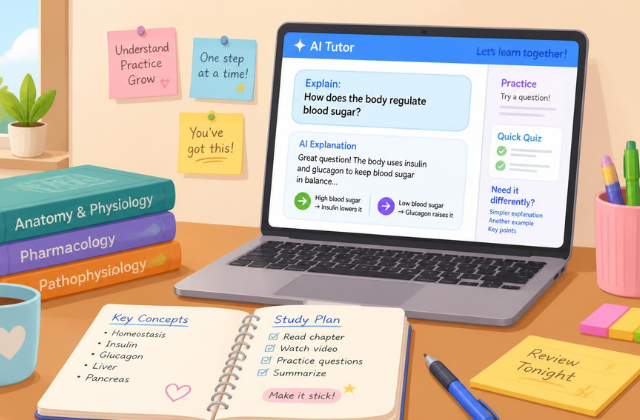
The first nursing student to use ChatGPT to untangle a difficult concept was not necessarily taking a shortcut. Students have always looked for another explanation before an exam or clinical shift. The difference is scale. Today, a generative AI tool can summarize pathophysiology, draft a care plan, generate practice questions, suggest documentation, and produce a confident response to a clinical scenario in seconds.
That convenience is why nursing education must take AI dependency seriously. AI use among nursing students is already common for study support, assignment preparation, clinical cases, and exam review. The question is no longer whether students will use AI. It is whether we are teaching them to use it in ways that deepen clinical judgement or quietly replace it.
AI can absolutely enhance learning. It can provide personalized explanations, rapid feedback, practice questions, and help with language and expression. It may be particularly useful when a student needs a concept explained differently or wants to rehearse knowledge outside class time. It also has a practical place in education because new graduates will increasingly encounter AI-enabled documentation, decision-support tools, and digital systems in clinical practice.
The goal, however, must be augmentation, not substitution. AI should support learning, prompt questions, and encourage reflection. It should not do the clinical reasoning that students must eventually perform independently at the bedside. The College of Registered Nurses of Alberta similarly emphasizes that AI should enhance but not replace clinical judgement and human connection (CRNA, 2025).
Clinical judgement is a core competency in nursing, and it is more than retrieving information or selecting an intervention from a list. It requires nurses to recognize meaningful cues, identify deterioration, interpret findings in context, notice what information is missing, prioritize concerns, act safely, and evaluate the patient’s response. Those abilities develop through repeated practice, feedback, uncertainty, and reflection. However, AI dependency can interfere with that development.
Over reliance on AI can lead to premature closure; an instance where an apparently complete answer prevents a student from considering alternatives. A chatbot might identify a patient’s dyspnea as anxiety or fluid overload, but an independent nurse must consider other possibilities and what assessment data are still needed before making a conclusion. AI dependence can also encourage automation bias, a situation where a student gives too much weight to an automated recommendation because it sounds confident. AI-generated content can be fluent and persuasive while still containing fabricated references, outdated information, incomplete rationale, bias, or advice that does not fit the patient’s circumstances. A polished answer is not necessarily a safe one, and higher levels of dependence and trust in AI have been associated with automation bias in complex ethical decision-making contexts (Sengul et al., 2025).
There is also the risk of reduced “cognitive reps.” Students develop clinical reasoning by identifying cues, explaining why they matter, tolerating uncertainty, looking for evidence that challenges an initial impression, and defending their priorities. If AI routinely performs those steps, students may submit strong-looking care plans without developing the mental habits needed when a tool is unavailable or wrong. AI may organize information efficiently, but it cannot independently assess a patient, notice a subtle change in affect, establish therapeutic trust, understand a family’s circumstances, or negotiate what matters most to a person receiving care. Those are things AI cannot replace. A nurse cannot transfer professional accountability to a chatbot. The RN remains responsible for assessing, questioning, escalating, and acting in the patient’s best interests (Sahin & Yildirim, 2026).
That is why AI literacy must mean more than writing an effective prompt. Nursing students need to know what to ask, what information is missing, and when an answer should be doubted. AI is most likely to impair clinical judgement when it becomes the answer-generator. It is most likely to support judgement when it becomes an object of critique, comparison, and reflection. So, to protect clinical judgment, nursing education should aim for calibrated reliance. Students should know when AI is useful, when it is inappropriate, and how to verify it independently. Nursing courses should require an independent first pass on clinical cases. Before consulting AI, students should identify salient cues, state priority concerns, describe additional assessment needed, and explain their rationale. AI can then become a comparison point, not a replacement for their thinking.
Assignments can also require students to audit an AI-generated answer against course material, clinical guidelines, or primary evidence. Students should be able to identify omissions, unsupported claims, bias, unsafe recommendations, and failures to account for the patient’s context. Assessments need to make thinking visible, so including simulation debriefs, observed performance, and think-aloud prioritization are better measures of clinical reasoning than a polished written submission alone. Nursing programs should retain clearly identified AI-free assessments for foundational reasoning, communication, and bedside assessment. In the end, AI should enhance rather than replace clinical judgement and human connection. Nursing programs should adopt the same standard. Teach students to use AI. Require them to disclose it. Make them verify it. Ensure they understand that identifiable patient information should never be entered into unapproved public AI tools. Continue to assess the parts of nursing that no chatbot can be entrusted to own: observation, reasoning, accountability, advocacy, and care for the person in front of them.
A registered nurse will increasingly work alongside digital tools, decision-support systems, and artificial intelligence. Pretending otherwise would be poor preparation. But so would graduating nurses who accept fluent answers without tracing the evidence, testing the reasoning, or recognizing what the answer missed. Nursing students are already using generative AI. The question is whether we have designed nursing education to help them become safer clinicians or more dependent users.
References
College of Registered Nurses of Alberta. (2025, September). Artificial intelligence: Practice advice. https://www.nurses.ab.ca/media/ejrbfpgl/artificial-intelligence-practice-advice-crna-2025.pdf
Sahin, N. D., & Yildirim, M. (2026). Nursing students’ experiences with artificial intelligence: A qualitative study on education, clinical practice, and future expectations. Journal of Evaluation in Clinical Practice. Advance online publication. https://doi.org/10.1111/jep.7041
Sengul, T., Sariköse, S., & Gul, A. (2025). Ethical decision-making and artificial intelligence in nursing education: An integrative review. Nursing Ethics, 32(8), 2490–2515. https://doi.org/10.1177/09697330251366600


Recent articles
- Index of volume 21 number 321 Sep 2026
- Cyber Security Awareness Month in the Age of AI21 Sep 2026
- Are we supporting the next generation of nurses to be AI proficient or AI dependent?21 Sep 2026
- Designing What AI Makes Possible in Healthcare21 Sep 2026
- Cybersecurity Threats to Hospital Information Systems: A Narrative Review of Risks, Patient-Safety Impacts, and Defensive Strategies with Implications for the United States21 Sep 2026