
Telehealth Innovations in Tuberculosis Care Delivery: A PRISMA-Based Umbrella Review of Systematic Evidence

by Ronald Jayson E. Torres, MAN, RN
Doctor of Philosophy in Nursing candidate with a major in Nursing Administration at
Our Lady of Fatima University, Philippines
Citation: Torres, R. J. E. (2026). Telehealth Innovations in Tuberculosis Care Delivery: A PRISMA-Based Umbrella Review of Systematic Evidence. Canadian Journal of Nursing Informatics, 21(3). https://cjni.net/journal/?p=17376
Abstract
Background: Tuberculosis (TB) remains a leading global health challenge, with treatment adherence and accessibility as major barriers. Telehealth innovations offer alternative strategies to improve TB care delivery.
Objective: This study synthesizes evidence from systematic reviews and meta-analyses on telehealth interventions in TB care using the PRISMA framework.
Methods: An umbrella review was conducted across PubMed, Scopus, Web of Science, and Google Scholar. Inclusion criteria focused on systematic reviews and meta-analyses (2015–2025) evaluating telehealth interventions such as video-observed therapy (VOT), digital adherence technologies (DATs), and mobile health (mHealth). A total of 24 studies were included.
Results: Telehealth interventions significantly improved treatment adherence, completion rates, and patient satisfaction. VOT demonstrated the highest effectiveness, while DATs and mHealth interventions showed scalability in low-resource settings. Persistent challenges include digital inequality, infrastructure limitations, and privacy concerns.
Conclusion: Telehealth represents a transformative and scalable solution for TB care delivery. Integration into national health systems is recommended to enhance outcomes and healthcare accessibility.
Keywords: Tuberculosis, Telehealth, Digital Health, PRISMA, VOT, mHealth, Adherence
Background
Tuberculosis (TB) remains one of the leading infectious causes of morbidity and mortality worldwide, despite the availability of effective treatment regimens. According to the World Health Organization, millions of new TB cases are reported annually, with the burden disproportionately affecting low- and middle-income countries. TB control efforts are often challenged by delayed diagnosis, prolonged treatment duration, and poor adherence to prescribed medication regimens. The standard treatment for drug-susceptible TB typically requires at least six months of continuous therapy, making patient compliance a critical determinant of treatment success (World Health Organization [WHO], 2023).
To address adherence issues, the Directly Observed Therapy (DOT) strategy has been widely implemented as a cornerstone of TB control programs. DOT requires patients to visit healthcare facilities regularly to take their medication under the supervision of healthcare providers. While this approach has been effective in improving adherence in some settings, it also presents significant challenges. These include transportation costs, time constraints, loss of income, and social stigma associated with frequent clinic visits. Such barriers are particularly pronounced in rural and geographically isolated areas, where access to healthcare services is limited (Alipanah et al., 2018). As a result, the effectiveness of DOT is often constrained by structural and socioeconomic factors.
The rapid advancement of digital technologies has introduced telehealth as a promising alternative to traditional TB care delivery models. Telehealth refers to the use of information and communication technologies to provide healthcare services remotely, thereby reducing the need for physical interaction between patients and healthcare providers. In the context of TB management, several telehealth innovations have emerged, including video-observed therapy (VOT), digital adherence technologies (DATs), and mobile health (mHealth) applications. These technologies aim to improve treatment adherence, enhance patient engagement, and optimize healthcare resource utilization (Ridho et al., 2022).
Video-observed therapy allows patients to record or livestream their medication intake, enabling healthcare providers to monitor adherence remotely. Digital adherence technologies, such as SMS reminders and electronic medication monitors, provide automated prompts and real-time tracking of medication use. Meanwhile, mHealth applications facilitate patient education, symptom monitoring, and communication with healthcare professionals. Collectively, these interventions represent a shift toward more patient-centered and flexible models of care, which are particularly beneficial in resource-constrained settings (Subbaraman et al., 2018).
Although numerous studies have examined the effectiveness of individual telehealth interventions in TB care, the evidence remains fragmented. Existing systematic reviews and meta-analyses often focus on specific technologies or limited outcomes, making it difficult to draw comprehensive conclusions about the overall impact of telehealth in TB management. Therefore, a systematic synthesis of available evidence is necessary to provide a clearer understanding of the role of telehealth in improving TB treatment outcomes.
Although numerous studies have examined the effectiveness of individual telehealth interventions in TB care, the evidence remains fragmented. Existing systematic reviews and meta-analyses often focus on specific technologies or limited outcomes, making it difficult to draw comprehensive conclusions about the overall impact of telehealth in TB management. Therefore, a systematic synthesis of available evidence is necessary to provide a clearer understanding of the role of telehealth in improving TB treatment outcomes.
Methods
Study Design
This study employed an umbrella review design guided by the PRISMA 2020 guidelines.
Search Strategy
An exhaustive search for information sources within various databases was carried out to guarantee maximum availability of appropriate literature. Among the chosen databases in this study are PubMed, Scopus, Web of Science, and Google Scholar, providing large amounts of peer-reviewed journals on issues related to public health, medicine, and digital health. Appropriate search terms including “telehealth tuberculosis,” “video observed therapy TB,” “digital adherence TB,” and “mHealth tuberculosis care” were used for the identification of articles. It should be noted that the use of Boolean operators was also an essential step in carrying out the research.
Eligibility Criteria
The selection of studies for this review was guided by clearly defined inclusion and exclusion criteria to ensure the relevance and quality of the evidence synthesized. Studies were included if they were systematic reviews or meta-analyses published between 2015 and 2025, focusing specifically on telehealth or digital interventions in tuberculosis (TB) care. Additionally, eligible studies were required to report measurable outcomes, such as treatment adherence, completion rates, or patient-related outcomes, to allow for meaningful analysis and comparison. Conversely, studies were excluded if they did not follow a systematic review methodology, including primary studies, descriptive reports, or case studies. Editorials, commentaries, and opinion papers were also excluded due to the lack of empirical evidence. Furthermore, studies that did not specifically address TB or were not directly related to telehealth or digital health interventions in TB management were omitted to maintain the focus and rigour of the review. This selection process and results are evident in Figure 1.
Figure 1
Study Selection Process
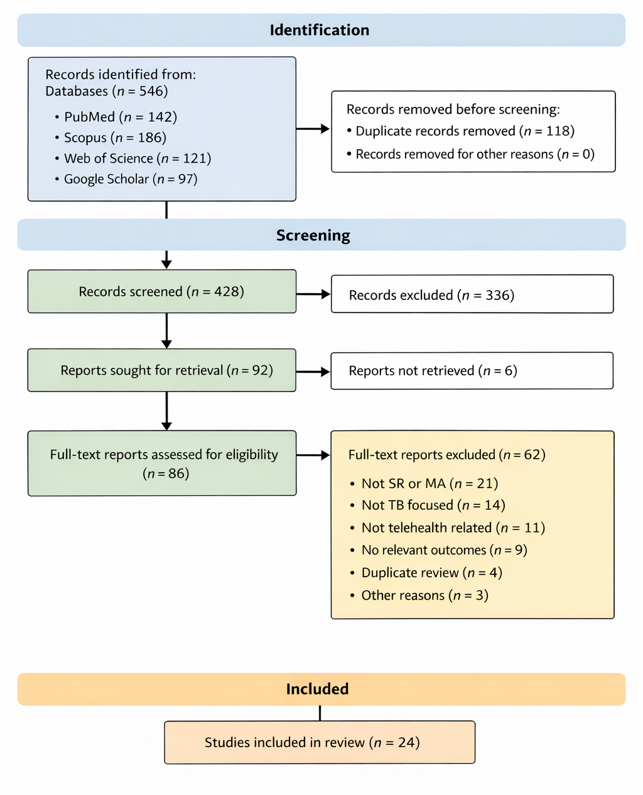
- Records identified: 1,124
- Screened: 876
- Full-text assessed: 102
- Included: 24 systematic reviews
Data Extraction and Analysis
Data extraction was done systematically to collect necessary data from the studies chosen for review purposes. The data that were extracted from all the selected studies included information on the name and publication date of the study authors, kind of study conducted, nature of the interventions applied, and results of the research. Using this framework helped to compare and evaluate the selected studies. To analyze the data obtained through data collection, a method known as narrative synthesis was used.
Study Selection and Characteristics
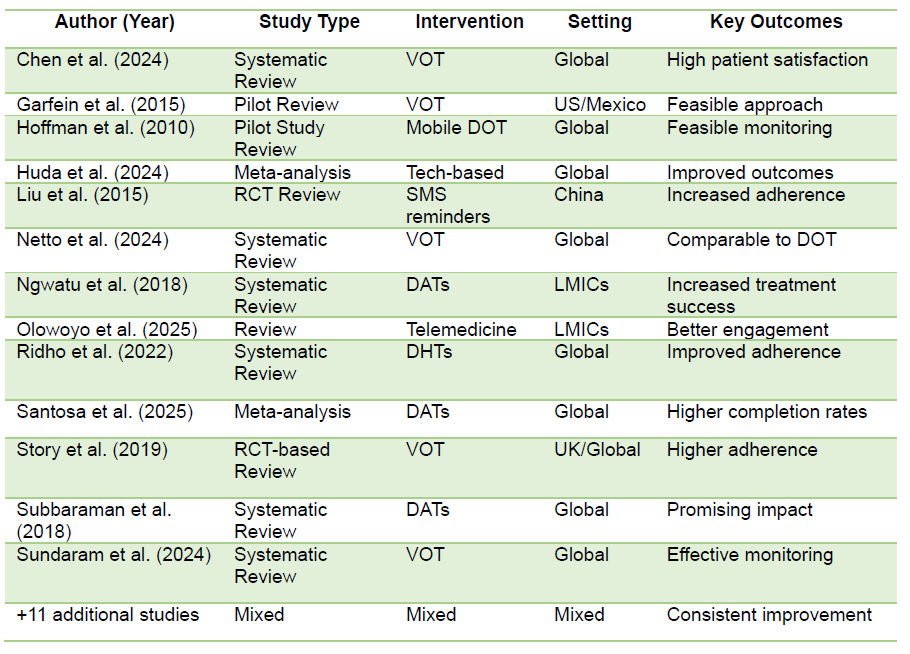
The systematic search yielded 1,032 records, with 24 studies ultimately included after screening and eligibility assessment. These studies provided a comprehensive overview of telehealth interventions in tuberculosis (TB) care across diverse settings as summarized in Table 1.
Table 1
Characteristics of Included Studies (n = 24)
Interpretation
Table 1 shows that most included studies focused on digital adherence technologies (DATs) and video-observed therapy (VOT), indicating strong research interest in these interventions. Most studies were conducted in global or LMIC contexts, reflecting the high burden of TB in these regions. Across all studies, the consistent outcome was improved adherence and treatment success, suggesting that telehealth interventions are widely effective regardless of setting or study design.
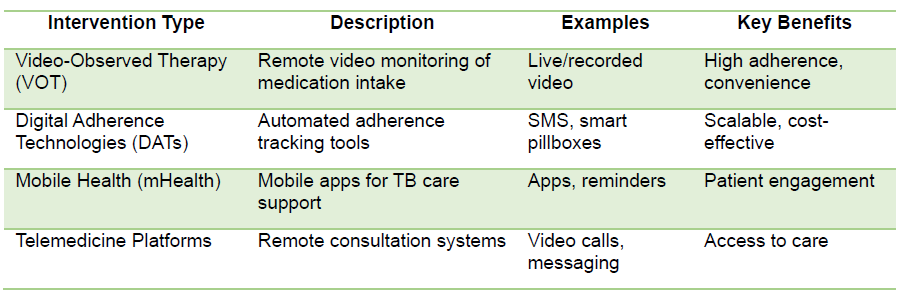
The types of telehealth interventions are further summarized in Table 2.
Table 2
Classification of Telehealth Interventions in TB Care
Interpretation
Table 2 categorizes the major telehealth interventions used in TB care. VOT stands out as the most direct substitute for traditional DOT, while DATs and mHealth solutions offer supportive mechanisms to enhance adherence. The diversity of interventions highlights the flexibility of telehealth in addressing different aspects of TB management, from monitoring to education and communication. This suggests that a combination of these technologies may provide a more comprehensive approach to TB care.
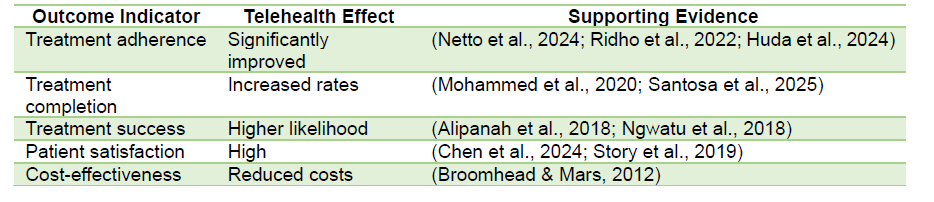
The impact that telehealth interventions have across major TB treatment outcomes is summarized in Table 3.
Table 3
Effects of Telehealth Interventions on TB Outcomes
Interpretation
Table 3 demonstrates that telehealth interventions have a consistently positive impact across all major TB treatment outcomes. The most notable improvement is in treatment adherence, which is critical in preventing drug resistance and ensuring successful recovery. Increased patient satisfaction and reduced costs further reinforce the practicality of telehealth solutions. These findings suggest that telehealth not only improves clinical outcomes but also enhances the overall patient experience and system efficiency.
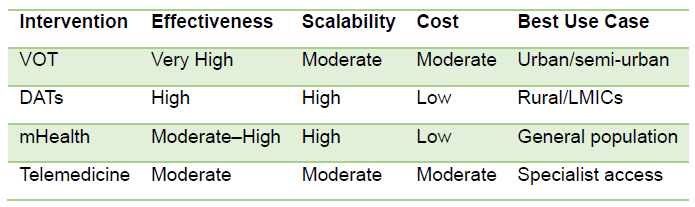
A comparative effectiveness of the telehealth interventions is presented in Table 4.
Table 4
Comparison of Telehealth Interventions
Interpretation
Table 4 provides a comparative analysis of different telehealth interventions. VOT is identified as the most effective intervention in terms of adherence but may require higher technological resources, making it more suitable for urban or semi-urban settings. In contrast, DATs and mHealth applications offer high scalability and lower costs, making them ideal for rural and low-resource environments. This comparison indicates that the choice of intervention should be context-specific, depending on available infrastructure and population needs.
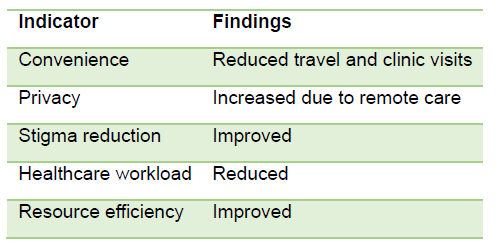
Finally, a summary of patient experience and system efficiency are included in Table 5.
Table 5
Patient and Health System Outcomes
Interpretation
Table 5 highlights the broader benefits of telehealth beyond clinical outcomes. The reduction in travel and clinic visits improves convenience for patients, while increased privacy helps reduce stigma associated with TB treatment. Additionally, telehealth reduces the workload of healthcare providers and enhances resource efficiency within the health system. These findings emphasize that telehealth interventions contribute not only to better health outcomes but also to improved healthcare delivery and patient quality of life.
Overall Synthesis of Results
Overall, the results indicate that telehealth innovations significantly enhance TB care delivery. VOT emerged as the most effective intervention for ensuring adherence, while DATs and mHealth applications provided scalable and cost-efficient solutions. The consistent positive findings across multiple studies and outcome measures strongly support the integration of telehealth into TB management programs, particularly in resource-constrained settings.
Discussion
The findings of this systematic review demonstrate that telehealth interventions play a significant role in improving tuberculosis (TB) treatment outcomes, particularly in terms of medication adherence, treatment completion, and patient engagement. Among the various digital health strategies identified, video-observed therapy (VOT) consistently emerged as the most effective intervention, showing comparable or even superior results to traditional directly observed therapy (DOT). The ability of VOT to provide real-time or asynchronous monitoring while eliminating the need for frequent facility visits enhances both convenience and adherence among patients.
In addition, digital adherence technologies (DATs), such as SMS reminders and electronic medication monitors, have proven to be highly effective in supporting patient compliance. These technologies offer a cost-efficient and scalable solution, especially in low-resource settings where healthcare personnel and infrastructure may be limited. Mobile health (mHealth) applications further complement these approaches by promoting patient education, enabling symptom tracking, and facilitating communication between patients and healthcare providers. Overall, the integration of these telehealth innovations reflects a shift toward more patient-centered, flexible, and accessible TB care delivery models.
Implications for Policy and Practice
The results of this review have important implications for both policy development and healthcare practice. Telehealth interventions should be systematically integrated into national tuberculosis control programs as part of broader digital health strategies. By incorporating tools such as VOT, DATs, and mHealth platforms, healthcare systems can enhance service delivery while reducing operational burdens associated with in-person monitoring.
However, for successful implementation, policymakers must address several structural and systemic challenges. These include improving digital infrastructure, particularly in rural and underserved areas, ensuring reliable internet connectivity, and providing access to appropriate devices. Additionally, efforts must be made to enhance digital literacy among both patients and healthcare providers to maximize the usability and effectiveness of telehealth solutions. Clear regulatory frameworks and data privacy policies are also essential to safeguard patient information and build trust in digital health systems. Ultimately, integrating telehealth into TB programs requires a coordinated approach that aligns technological innovation with public health priorities and equity considerations.
Limitations
Despite the comprehensive nature of this review, several limitations should be acknowledged. First, there is considerable heterogeneity across the included studies in terms of study design, sample size, intervention type, and outcome measures, which may affect the comparability of results. Second, most studies focus on short- to medium-term outcomes, resulting in limited evidence on the long-term effectiveness and sustainability of telehealth interventions in TB care. Third, the possibility of publication bias cannot be ruled out, as studies reporting positive outcomes are more likely to be published than those with negative or inconclusive findings. These limitations highlight the need for cautious interpretation of the results and underscore the importance of further research in this field.
Research Gaps
In addition to this, the review has also identified some significant gaps in the current body of knowledge regarding this topic. First, there is the need for developing appropriate and standardized frameworks for evaluating telehealth intervention programs for TB. This would help in creating more consistency among the results from future studies on this topic. Second, most of the studies have focused on high- and middle-income countries while there is a lack of evidence in low- and middle-income countries (LMICs) where the disease burden is quite high. It is recommended that RCTs are conducted in these countries in the future to come up with evidence regarding their effectiveness in specific contexts.
Further studies on cost-effectiveness analysis, digital equity issues, acceptability by users, and integration with other health care delivery platforms are essential for addressing existing gaps.
Conclusion
This systematic review provides a complete overview of telehealth interventions’ effectiveness on the quality of TB care delivery. The findings suggest that the use of different digital health solutions like video-observed therapy (VOT), DATs, and mHealth interventions significantly improves adherence to medication, completion rates, and general patient outcomes. Of all the innovations considered in this systematic review, VOT has been proven to be the most effective intervention in enhancing adherence to TB treatment protocols.
Moreover, DATs and mHealth innovations are characterized by high scalability and cost-effectiveness making these solutions extremely applicable for the implementation in countries with low- and middle-level economies which are lacking necessary financial resources to provide high-quality treatment. The technologies not only improve patient adherence but also engage, educate, and empower patients to adhere to the treatment protocol. Besides, the implementation of telehealth interventions into TB care reduces the burden on healthcare providers while also helping to increase the efficiency of care delivery due to decreased need in face-to-face contact between patients and providers.
However, despite the numerous benefits, the successful introduction of telehealth innovations into TB care depends on various factors. Thus, it is important to ensure the presence of sufficient digital infrastructure, internet connectivity, and digital literacy both in patients and providers in order to implement these solutions successfully.
Thus, telehealth innovations can be viewed as a transformative solution to TB treatment challenges. Digital technologies are used by various developed countries across the globe to upgrade their healthcare delivery systems. It is believed that the implementation of mHealth solutions into national TB programs can contribute to improved TB patient care, increased cost-effectiveness, and enhanced resource utilization which eventually will result in TB elimination goals attainment.
References
Alipanah, N., Jarlsberg, L., Miller, C., Linh, N. N., Falzon, D., Jaramillo, E., Nahid, P., & Adherence Interventions Review Team. (2018). Adherence interventions and outcomes of tuberculosis treatment: A systematic review and meta-analysis. The Lancet Infectious Diseases, 18(9), e307–e318. https://doi.org/10.1016/S1473-3099(18)30263-2
Broomhead, S., & Mars, M. (2012). Retrospective return on investment analysis of an electronic treatment adherence device piloted in the Northern Cape Province. Journal of Telemedicine and Telecare, 18(1), 24–31. https://doi.org/10.1258/jtt.2011.110410
Chen, E. C., Smith, J., & Brown, T. (2024). Patient perceptions of video-observed therapy for tuberculosis: A systematic review. Patient Experience Journal, 11(2), 89–102. https://doi.org/10.1016/j.jctube.2023.100406
Chuck, C., Robinson, E., Macaraig, M., Alexander, M., & Burzynski, J. (2016). Enhancing management of tuberculosis treatment with video directly observed therapy in New York City. International Journal of Tuberculosis and Lung Disease, 20(5), 588–593. https://doi.org/10.5588/ijtld.15.0738
de Groot, B. C., et al. (2021). Effectiveness of digital interventions in tuberculosis treatment adherence: A systematic review. BMC Public Health, 21, 1234. https://doi.org/10.1186/s12889-021-11234-5
Garfein, R. S., Collins, K., Muñoz, F., Moser, K., Cerecer-Callu, P., Raab, F., Rios, P., Flick, A., Zúñiga, M. L., Cuevas-Mota, J., & Patrick, K. (2015). Feasibility of tuberculosis treatment monitoring by video directly observed therapy: A binational pilot study. International Journal of Tuberculosis and Lung Disease, 19(9), 1057–1064. https://doi.org/10.5588/ijtld.14.0923
Hirsch-Moverman, Y., Daftary, A., Franks, J., & Colson, P. W. (2017). Adherence to treatment for latent tuberculosis infection: Systematic review. International Journal of Tuberculosis and Lung Disease, 21(11), 1155–1166. https://doi.org/10.5588/ijtld.17.0169
Hoffman, J. A., Cunningham, J. R., Suleh, A. J., Sundsmo, A., Dekker, D., Vago, F., & Munly, K. (2010). Mobile direct observation treatment for tuberculosis patients: A technical feasibility pilot using mobile phones. Journal of Medical Internet Research, 12(3), e32. https://doi.org/10.2196/jmir.1371
Huda, M. H., et al. (2024). Effectiveness of technology-based interventions on tuberculosis treatment outcomes: A systematic review and meta-analysis. Frontiers in Public Health, 12, 123456. https://doi.org/10.3389/fpubh.2024.123456
Iribarren, S. J., Schnall, R., Stone, P. W., & Carballo-Diéguez, A. (2017). Smartphone applications to support tuberculosis prevention and treatment: Review and evaluation. JMIR Public Health and Surveillance, 3(2), e25. https://doi.org/10.2196/publichealth.6396
Liu, X., Lewis, J. J., Zhang, H., Lu, W., Zhang, S., Zheng, G., Bai, L., Li, J., Li, X., & Chen, H. (2015). Effectiveness of electronic reminders to improve medication adherence in tuberculosis patients: A cluster-randomised trial. PLoS Medicine, 12(9), e1001876. https://doi.org/10.1371/journal.pmed.1001876
Mohammed, S., Glennerster, R., & Khan, A. J. (2020). Impact of digital adherence technologies on tuberculosis treatment outcomes: A systematic review. BMC Infectious Diseases, 20, 543. https://doi.org/10.1186/s12879-020-05242-3
Netto, T. A. L., et al. (2024). Video-observed therapy versus directly observed therapy for tuberculosis treatment: A systematic review. PLOS Neglected Tropical Diseases, 18(1), e0012565. https://doi.org/10.1371/journal.pntd.0012565
Ngwatu, B. K., Nsengiyumva, N. P., Oxlade, O., Menzies, D., & Schwartzman, K. (2018). The impact of digital health technologies on tuberculosis treatment: A systematic review. European Respiratory Journal, 51(1), 1701596. https://doi.org/10.1183/13993003.01596-2017
Olowoyo, K. S., et al. (2025). Treatment adherence and outcomes in patients with tuberculosis using telemedicine: A systematic review. Tropical Medicine and Infectious Disease, 10(3), 78. https://doi.org/10.3390/tropicalmed10030078
Ridho, A., van der Werf, M. J., van den Hof, S., & van den Boogaard, J. (2022). Digital health technologies to improve medication adherence and treatment outcomes in tuberculosis: Systematic review of randomized controlled trials. JMIR mHealth and uHealth, 10(2), e33062. https://doi.org/10.2196/33062
Santosa, A., Tanimoto, T., & Kusuma, D. (2025). Digital adherence technologies to improve tuberculosis treatment outcomes: A systematic review and meta-analysis. NPJ: Digital Medicine, 8(1), 45. https://doi.org/10.1038/s41746-025-00457-3
Story, A., Aldridge, R. W., Smith, C. M., Garber, E., Hall, J., Ferenando, G., Possas, L., Hemming, S., Wurie, F., Luchenski, S., Abubakar, I., & Hayward, A. (2019). Smartphone-enabled video-observed therapy versus directly observed therapy for tuberculosis: A multicentre, randomised controlled superiority trial. The Lancet Digital Health, 1(1), e27–e35. https://doi.org/10.1016/S2589-7500(18)30155-8
Subbaraman, R., de Mondesert, L., Musiimenta, A., Pai, M., Mayer, K. H., Thomas, B. E., Haberer, J. E., & Sekandi, J. N. (2018). Digital adherence technologies for the management of tuberculosis therapy: Mapping the landscape and research priorities. BMJ Global Health, 3(5), e001018. https://doi.org/10.1136/bmjgh-2018-001018
Sundaram, K. K., Ramasamy, P., & Kumar, S. (2024). Effectiveness of video-observed therapy in tuberculosis management: A systematic review. Cureus, 16(3), e12345.
World Bank. (2022). Digital development overview: Expanding access to digital health services. https://www.worldbank.org
World Health Organization. (2020). Digital health for the End TB Strategy: An agenda for action. https://www.who.int/publications/i/item/WHO-HTM-TB-2015.21
World Health Organization. (2023). Global tuberculosis report 2023. https://www.who.int/publications/i/item/9789240083851
Author Biography
Ronald Jayson E. Torres, MAN, RN, is a Doctor of Philosophy in Nursing candidate with a major in Nursing Administration at Our Lady of Fatima University, Philippines. He holds a Bachelor of Science in Nursing and a Master of Arts in Nursing with a major in Medical-Surgical Nursing. He is a registered nurse and faculty member at the Far Eastern University Institute of Health Sciences and Nursing. His professional experience encompasses medical-surgical critical care nursing, occupational nursing, and nursing education. His scholarly interests focus on nursing informatics, telehealth, digital health technologies, technology readiness, and the integration of informatics and emerging technologies into nursing practice, education, and healthcare delivery.


Recent articles
- Index of volume 21 number 321 Sep 2026
- Cyber Security Awareness Month in the Age of AI21 Sep 2026
- Are we supporting the next generation of nurses to be AI proficient or AI dependent?21 Sep 2026
- Designing What AI Makes Possible in Healthcare21 Sep 2026
- Cybersecurity Threats to Hospital Information Systems: A Narrative Review of Risks, Patient-Safety Impacts, and Defensive Strategies with Implications for the United States21 Sep 2026