
Clinical Decision Support Systems in Nursing Informatics: Transforming Care Through Technology

by Hanaa Mohamed Ezzat RN, Informatics Nurse
Nursing informatics department, Hamad Medical Corporation, Doha, Qatar
Citation: Ezzat, H. M. (2026). Clinical decision support systems in nursing informatics: Transforming care through technology. Canadian Journal of Nursing Informatics, 21(1). https://cjni.net/journal/?p=16098
Abstract
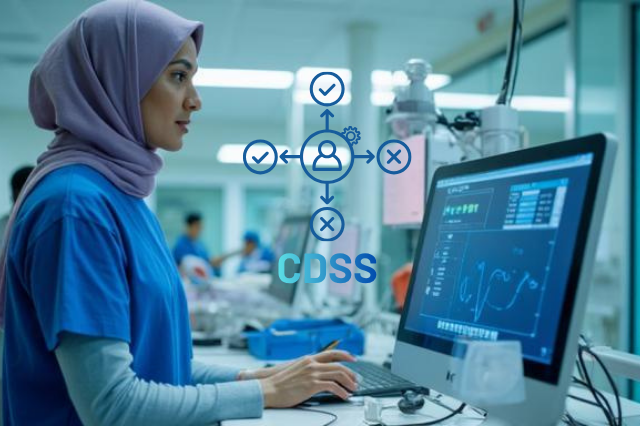
The integration of Clinical Decision Support Systems (CDSS) into nursing informatics has transformed healthcare delivery. By providing evidence-based guidance at the point of care, CDSS enhances clinical decision-making, reduces errors, and promotes patient-centered care. Nursing informatics bridges nursing science, information management, and technology, playing a critical role in the adoption, optimization, and effective use of these systems. This review examines the role of CDSS in healthcare, its impact on nursing practice, challenges in implementation, and future directions. Emphasis is given to usability, interoperability, ethical considerations, and the potential of emerging technologies such as artificial intelligence (AI), blockchain, and telehealth to enhance CDSS effectiveness across diverse care settings.
Background
Healthcare delivery has grown increasingly complex, requiring timely, accurate, and evidence-based decisions. Clinical Decision Support Systems (CDSS) provide real-time alerts, reminders, and diagnostic recommendations that support clinical decision-making and improve patient safety (Sutton et al., 2020). Nursing informatics—a discipline combining nursing science, computer science, and information management—optimizes the collection, analysis, and application of clinical data, supporting evidence-based practice (McGonigle & Mastrian, 2018). Together, CDSS and nursing informatics enhance clinical workflows, improve patient outcomes, and foster efficient, patient-centered care. This article review explores the role of CDSS in modern healthcare, their benefits, challenges to implementation, and emerging opportunities to maximize their impact in nursing practice.
Methods
This review used a narrative literature review approach. Relevant peer-reviewed articles, reports, and guidelines were identified through searches of major academic databases such as PubMed, CINAHL, Scopus, and Google Scholar. Keywords used included “Clinical Decision Support Systems,” “nursing informatics,” “patient safety,” “workflow efficiency,” and “healthcare technology.” Articles published in English and focused on CDSS implementation, nursing practice, and healthcare outcomes were considered. The selected literature was analyzed, synthesized, and organized into thematic areas, including benefits, challenges, and future directions of CDSS in nursing informatics.
Results
The reviewed literature consistently demonstrated that Clinical Decision Support Systems (CDSS) positively influence nursing practice and patient outcomes. Evidence showed significant reductions in medication errors, improved adherence to clinical guidelines, and enhanced workflow efficiency through automated alerts, reminders, and documentation support. Studies also highlighted the role of CDSS in strengthening patient engagement by providing tailored educational resources that support shared decision-making. Additionally, predictive analytics within CDSS were found to enhance early identification of clinical risks such as sepsis, falls, and pressure injuries, enabling timely interventions. Despite these benefits, challenges, including alert fatigue, usability issues, and limited interoperability, were frequently reported across studies. Overall, the findings indicated that while CDSS offer substantial value in nursing informatics, their effectiveness depends heavily on system design, integration with workflows, and adequate user training.
Discussion
Clinical Decision Support Systems (CDSS) in healthcare
Clinical Decision Support Systems (CDSS) enhance patient safety, care quality, and clinical efficiency by analyzing complex patient data and providing actionable insights directly within electronic health records (EHRs). These systems leverage algorithms, predictive models, and evidence-based guidelines to support clinical decision-making, helping clinicians make timely and informed choices. Research has shown that CDSS can improve adherence to clinical guidelines by up to 20% (Bright et al., 2012), reduce medication errors, and decrease adverse events in various healthcare settings.
Beyond error reduction, CDSS enables personalized care by tailoring recommendations to individual patient profiles, including comorbidities, laboratory results, prior treatments, and genetic information (Bates et al., 2018). For example, sepsis-prediction models integrated into CDSS use real-time patient data. such as vital signs, laboratory results, and comorbidities to identify early physiological changes that may indicate the onset of sepsis. By continuously monitoring these risk factors, the system can alert clinicians to patients at high risk before clinical symptoms become severe, prompting timely interventions. Studies have shown that this proactive approach not only reduces delays in diagnosis but also decreases the incidence of septic shock and organ failure, ultimately improving survival rates in intensive care units. Other applications include drug-drug interaction alerts, preventive care reminders, and diagnostic support, which collectively contribute to improved clinical outcomes and resource utilization (Goh et al., 2021).
Nursing Informatics and the Integration of CDSS
Nursing Informatics plays a critical role in supporting the effective integration of Clinical Decision Support Systems (CDSS) within healthcare settings. As a discipline that merges nursing science with information and computer sciences, Nursing Informatics aims to optimize data management and technology use to enhance patient care and clinical workflows (Garcia-Dia, 2021). CDSS, which provide evidence-based recommendations, alerts, and reminders, rely heavily on informatics principles to ensure they are usable, accurate, and aligned with nursing practice. Nursing Informatics contributes to customizing system interfaces, integrating CDSS into electronic health records, and ensuring that decision-support tools match clinical needs and workflows (HIMSS, 2021). Research shows that well-integrated CDSS can reduce medication errors, improve adherence to clinical guidelines, save documentation time, and enhance overall patient safety (Amin et al., 2024). However, successful adoption depends on adequate training, system usability, and organizational readiness, underscoring the essential role of Nursing Informatics in driving effective implementation and sustained use of CDSS (Kadvinskis et al., 2018).
Impact on Nursing Practice
CDSS influence nursing practice across multiple domains, from evidence-based care to risk management:
Evidence-Based Interventions
CDSS embed clinical guidelines directly into workflows, providing timely prompts, alerts, and recommendations at the point of care. This integration not only improves adherence to evidence-based protocols but also reduces variation in care across different nurses and shifts. Research shows that CDSS can reduce medication errors by up to 55% and improve compliance with clinical protocols by 30–68% (HealthIT.gov, 2021; Kawamoto et al., 2005; Baysari et al., 2021). This enhances patient safety, decreases nurses’ cognitive burden, and allows them to focus more on direct patient care and critical decision-making (Sloss & Jones, 2020).
Medication Safety
Medication administration errors remain a leading source of patient harm. Integrating CDSS with bar-code medication administration systems has reduced errors by 41% (Küng et al., 2021), providing immediate validation to ensure safe, timely delivery.
Workflow Efficiency
By automating documentation and task prioritization, clinical decision support systems (CDSS) reduce administrative burdens, allowing nurses to focus more on direct patient care. Evidence suggests that effective CDSS integration can reduce documentation time by up to 25%, freeing nurses from repetitive manual tasks (Holden et al., 2011). Beyond time savings, CDSS streamline workflow by organizing and prioritizing tasks, providing reminders for critical interventions, and reducing the likelihood of missed or duplicated entries.
Studies have also shown that incorporating structured data sets and standardized templates into electronic health records can further decrease the active time nurses spend on documentation and reduce the number of clicks required to complete essential tasks, sometimes by more than 70% (Bowman et al., 2019).
Patient Engagement and Education
CDSS support shared decision-making by providing condition-specific educational resources, tailored treatment options, and visual aids that help patients better understand their health status and care choices. These systems facilitate two-way communication between patients and clinicians, empowering patients to participate actively in their care plans. Studies report that the use of CDSS for patient education and engagement can improve patient satisfaction and involvement in care decisions by up to 20% (Chen et al., 2023; Légaré et al., 2018).
Risk Management and Professional Development
Predictive analytics integrated into CDSS help identify risks, such as falls, pressure ulcers, and sepsis, enabling proactive interventions (Choi et al., 2024; Khong et al., 2017). Additionally, CDSS fosters ongoing professional development through embedded learning modules that enhance diagnostic accuracy and critical thinking (Bertocchi et al., 2024).
Discussion
Challenges in Implementation
Despite their benefits, CDSS adoption faces barriers. Alert fatigue remains significant, with clinicians overriding nearly half of all alerts due to low specificity (Ancker et al., 2017). Usability issues affect users, often reflecting misalignment with clinical workflows (Chen et al., 2023; Khairat et al., 2018). Ethical concerns, including algorithmic bias, can disadvantage marginalized populations (Obermeyer et al., 2019), while accountability for automated recommendations remains unclear. Furthermore, interoperability limitations restrict full integration, with only one-third of U.S. hospitals achieving complete CDSS–EHR interoperability (Adler-Milstein et al., 2015). Effective deployment requires user-centered design, governance, and ongoing workforce training (Chen et al., 2023).
Future Directions
The next generation of CDSS will leverage AI, machine learning, and big data analytics to enhance predictive capabilities and support precision medicine (Rajkomar et al., 2019; Elhaddad & Hamam, 2024). Integration with wearable devices and telehealth platforms extends utility beyond hospitals, enabling remote monitoring and chronic disease management (Topol, 2019). Blockchain technology may enhance data security and interoperability, ensuring trust in data exchange (Azaria et al., 2016; Vijayalakshmi et al., 2021). Global initiatives, such as the WHO’s safer medication programs, underscore the need for CDSS adoption in resource-limited settings to improve patient safety worldwide (World Health Organization, 2017).
To maximize impact, evaluating CDSS post-implementation is essential. Key performance indicators (KPIs) should include reductions in adverse events, improved adherence to clinical guidelines, enhanced workflow efficiency, and staff satisfaction. Continuous monitoring and iterative improvements based on these metrics ensure that CDSS remain effective, safe, and aligned with both organizational goals and patient-centered care priorities.
Recommendations
From the author’s perspective, successful CDSS implementation requires a strategic approach that balances technology with human factors. Key recommendations include:
Workflow-Centered Design: CDSS should align with nursing workflows to enhance usability, minimize alert fatigue, and reflect operational realities in Qatari healthcare settings.
Ongoing Training: Continuous professional development ensures clinicians can effectively interpret and act on CDSS recommendations, integrating culturally and contextually relevant clinical decision-making.
Ethics and Governance: Robust frameworks must mitigate algorithmic bias, uphold ethical standards, and clarify accountability for automated decisions, in line with both global best practices and local regulations.
Leveraging Emerging Technologies: AI, blockchain, and telehealth can expand predictive capabilities, enable remote monitoring, and support scalable, patient-centered care, with phased adoption guided by local infrastructure readiness.
In Qatar, Nationwide CIS adoption, including Cerner at Hamad Medical Corporation, has streamlined documentation, consolidated patient records, and supported real-time decision-making. Programs such as the Ministry of Public Health’s Antimicrobial Stewardship initiative highlighted CDSS’s role in enhancing patient safety and rational prescribing locally.
Maximizing CDSS potential requires integrating technological innovation, workforce preparedness, ethical governance, and local contextual adaptation. Thoughtful implementation in Qatar can drive safer, more efficient, and patient-centered care while aligning with global best practices.
Conclusion
Clinical Decision Support Systems are reshaping nursing informatics by embedding evidence-based guidance into clinical workflows, enhancing safety, efficiency, and patient engagement. Their potential to reduce errors, improve adherence to best practices, and enable proactive risk management positions CDSS as a cornerstone of modern healthcare delivery.
However, challenges remain. Alert fatigue, usability concerns, data interoperability, and ethical issues, particularly bias and accountability, continue to hinder the full realization of CDSS benefits. Addressing these requires user-centered design, robust governance, and workforce training. Looking ahead, the integration of AI, blockchain, and telehealth holds promise for advancing CDSS beyond hospital walls, supporting personalized, equitable, and globally scalable healthcare. For nursing practice, CDSS represent not only a tool for decision-making but a catalyst for innovation, lifelong learning, and patient-centered care.
References
Adler-Milstein, J., Everson, J., & Lee, S. Y. (2015). EHR adoption and hospital performance: Time-related effects. Health Services Research, 50(6), 1751–1771. https://doi.org/10.1111/1475-6773.12406
Agency for Healthcare Research and Quality. (2019). Clinical decision support systems: State of the field. U.S. Department of Health & Human Services.
Amin, A. M., Ghaly, R., Abuelazm, M. T., et al. (2024). Clinical decision support systems to optimize adherence to anticoagulant guidelines in patients with atrial fibrillation: A systematic review and meta-analysis of randomized controlled trials. Thrombosis Journal, 22, 45. https://doi.org/10.1186/s12959-024-00614-7
Ancker, J. S., Edwards, A., Nosal, S., Hauser, D., Mauer, E., & Kaushal, R.; HITEC Investigators. (2017). Effects of workload, work complexity, and repeated alerts on alert fatigue in a clinical decision support system. BMC Medical Informatics and Decision Making, 17(1), 36. https://doi.org/10.1186/s12911-017-0430-8
Azaria, A., Ekblaw, A., Vieira, T., & Lippman, A. (2016). MedRec: Using blockchain for medical data access and permission management. In 2016 2nd International Conference on Open and Big Data (OBD) (pp. 25–30). IEEE. https://doi.org/10.1109/OBD.2016.11
Bates, D. W., Saria, S., Ohno-Machado, L., Shah, A., & Escobar, G. (2018). Big data in health care: Using analytics to identify and manage high-risk and high-cost patients. Health Affairs, 33(7), 1123–1131. https://doi.org/10.1377/hlthaff.2014.0041
Baysari, M. T., Duong, M. H., Hooper, P., Stockey Bridge, M., Awad, S., Zheng, W. Y., & Hilmer, S. N. (2021). Supporting deprescribing in hospitalised patients: Formative usability testing of a computerised decision support tool. BMC Medical Informatics and Decision Making, 21(1), 116. https://doi.org/10.1186/s12911-021-01484-z
Bertocchi, L., Dante, A., La Cerra, C., Masotta, V., Marcotullio, A., Caponnetto, V., et al. (2024). Nursing diagnosis accuracy in nursing education: Clinical decision support system compared with paper-based documentation—A before and after study. Computers, Informatics, Nursing, 42(1), 44–52. https://doi.org/10.1097/CIN.0000000000001066
Bowman, S. L., Chen, J., Morris, M., et al. (2019). Changes in efficiency and quality of nursing electronic health record documentation after implementation of an admission patient history essential data set. Computers, Informatics, Nursing, 37(5), 223–233. https://doi.org/10.1097/CIN.0000000000000515
Bright, T. J., Wong, A., Dhurjati, R., Bristow, E., Bastian, L., Coeytaux, R., et al. (2012). Effect of clinical decision-support systems: A systematic review. Annals of Internal Medicine, 157(1), 29–43. https://doi.org/10.7326/0003-4819-157-1-201207030-00450
Chen, Z., Liang, N., Zhang, H., Li, H., Yang, Y., Zong, X., et al. (2023). Harnessing the power of clinical decision support systems: Challenges and opportunities. Open Heart, 10, e002432. https://doi.org/10.1136/openhrt-2023-002432
Choi, A., Lee, K., Hyun, H., Kim, K. J., Ahn, B., Lee, K. H., et al. (2024). A novel deep learning algorithm for real-time prediction of clinical deterioration in the emergency department for a multimodal clinical decision support system. Scientific Reports, 14, 30116. https://doi.org/10.1038/s41598-024-80268-7
Elhaddad, M., & Hamam, S. (2024). AI-driven clinical decision support systems: An ongoing pursuit of potential. Cureus, 16(4), e57728. https://doi.org/10.7759/cureus.57728
Garcia-Dia, M. J. (2021). Nursing informatics: An evolving specialty. Nursing Management, 52(5), 56. https://doi.org/10.1097/01.NUMA.0000743444.08164.b4
Goh, K. H., Wang, L., Yeow, A. Y. K., Poh, H., Li, K., Yeow, J. J. L., & Tan, G. Y. H. (2021). Artificial intelligence in sepsis early prediction and diagnosis using unstructured data in healthcare. Nature Communications, 12, 711. https://doi.org/10.1038/s41467-021-20910-4
HealthIT.gov. (2021). Clinical decision support. U.S. Department of Health & Human Services.
Healthcare Information and Management Systems Society. (2021). Nursing informatics and CDSS.
Holden, R. J., Karsh, B. T., & Hundt, A. S. (2011). A human factors framework for improving safety and efficiency in EHR-mediated workflows. Health Informatics Journal, 17(2), 77–96. https://doi.org/10.1177/1460458210383880
Kadvinskis, I. M., Garvey Smith, J., & Yen, P. Y. (2018). Nurses’ experience with health information technology: Longitudinal qualitative study. JMIR Medical Informatics, 6(2), e38. https://doi.org/10.2196/medinform.8734
Kawamoto, K., Houlihan, C. A., Balas, E. A., & Lobach, D. F. (2005). Improving clinical practice using clinical decision support systems: A systematic review of trials to identify features critical to success. BMJ, 330(7494), 765. https://doi.org/10.1136/bmj.38398.500764.8F
Khairat, S., Marc, D., Crosby, W., & Al Sanousi, A. (2018). Reasons for physicians not adopting clinical decision support systems: Critical analysis. JMIR Medical Informatics, 6(2), e24. https://doi.org/10.2196/medinform.8912
Khong, P. C. B., Lee, L. N., & Dawang, A. I. (2017). Modeling the construct of an expert evidence-adaptive knowledge base for a pressure injury clinical decision support system. Informatics, 4(3), 20. https://doi.org/10.3390/informatics4030020
Küng, K., Aeschbacher, K., Rütsche, A., Goette, J., Zürcher, S., Schmidli, J., et al. (2021). Effect of barcode technology on medication preparation safety: A quasi-experimental study. International Journal for Quality in Health Care, 33(1), mzab043. https://doi.org/10.1093/intqhc/mzab043
Légaré, F., Stacey, D., Turcotte, S., Cossi, M. J., Kryworuchko, J., Graham, I. D., et al. (2018). Interventions for improving the adoption of shared decision making by healthcare professionals. Cochrane Database of Systematic Reviews, 7, CD006732. https://doi.org/10.1002/14651858.CD006732.pub4
McGonigle, D., & Mastrian, K. (2018). Nursing informatics and the foundation of knowledge (4th ed.). Jones & Bartlett Learning.
Obermeyer, Z., Powers, B., Vogeli, C., & Mullainathan, S. (2019). Dissecting racial bias in an algorithm used to manage the health of populations. Science, 366(6464), 447–453. https://doi.org/10.1126/science.aax2342
Rajkomar, A., Dean, J., & Kohane, I. (2019). Machine learning in medicine. New England Journal of Medicine, 380, 1347–1355. https://doi.org/10.1056/NEJMra1814259
Sloss, E. A., & Jones, T. L. (n.d.). Nurse cognition, decision support, and barcode medication administration: A conceptual framework for research, practice, and education. Nursing CE Connection. https://doi.org/10.1097/CIN.0000000000000724
Sutton, R. T., Pincock, D., Baumgart, D. C., Sadowski, D. C., Fedorak, R. N., & Kroeker, K. I. (2020). An overview of clinical decision support systems: Benefits, risks, and strategies for success. NPJ Digital Medicine, 3, 17. https://doi.org/10.1038/s41746-020-0221-y
Topol, E. (2019). Deep medicine: How artificial intelligence can make healthcare human again. Basic Books.
Vijayalakshmi, S., Savita, & Gayathri, S. P., Janarthanan, S. (2021). Blockchain security for artificial intelligence-based clinical decision support tool. In Internet of Things, Artificial Intelligence and Blockchain Technology (pp. 209–240). Springer.
World Health Organization. (2017). Medication errors: Technical series on safer primary care. https://www.who.int/publications/i/item/9789241511643
Author Bio
Hanaa Mohamed Ezzat, BSc Nursing, RN
Hanaa is an Informatics Nurse in the Nursing Informatics Department at Hamad Medical Corporation (HMC) in Doha, Qatar.


Recent articles
- Index of volume 21 number 321 Sep 2026
- Cyber Security Awareness Month in the Age of AI21 Sep 2026
- Are we supporting the next generation of nurses to be AI proficient or AI dependent?21 Sep 2026
- Designing What AI Makes Possible in Healthcare21 Sep 2026
- Cybersecurity Threats to Hospital Information Systems: A Narrative Review of Risks, Patient-Safety Impacts, and Defensive Strategies with Implications for the United States21 Sep 2026