
Informatics Strategies for Earth Month

by June Kaminski, RN MSN PhD(c)
Editor in Chief
CJNI was initiated by June Kaminski in 2006 when she was President-Elect of CNIA. In 2012, June was honoured to receive the CASN and Canada Health Infoway’s inaugural Nursing Faculty E-Health Award 2012 in Ottawa Canada. She offers the Nursing Informatics Learning Centre with accredited CEU informatics courses.
Citation: Kaminski, J. (2026). Editorial. Informatics strategies for Earth Month. Canadian Journal of Nursing Informatics, 21(1). https://cjni.net/journal/?p=16046
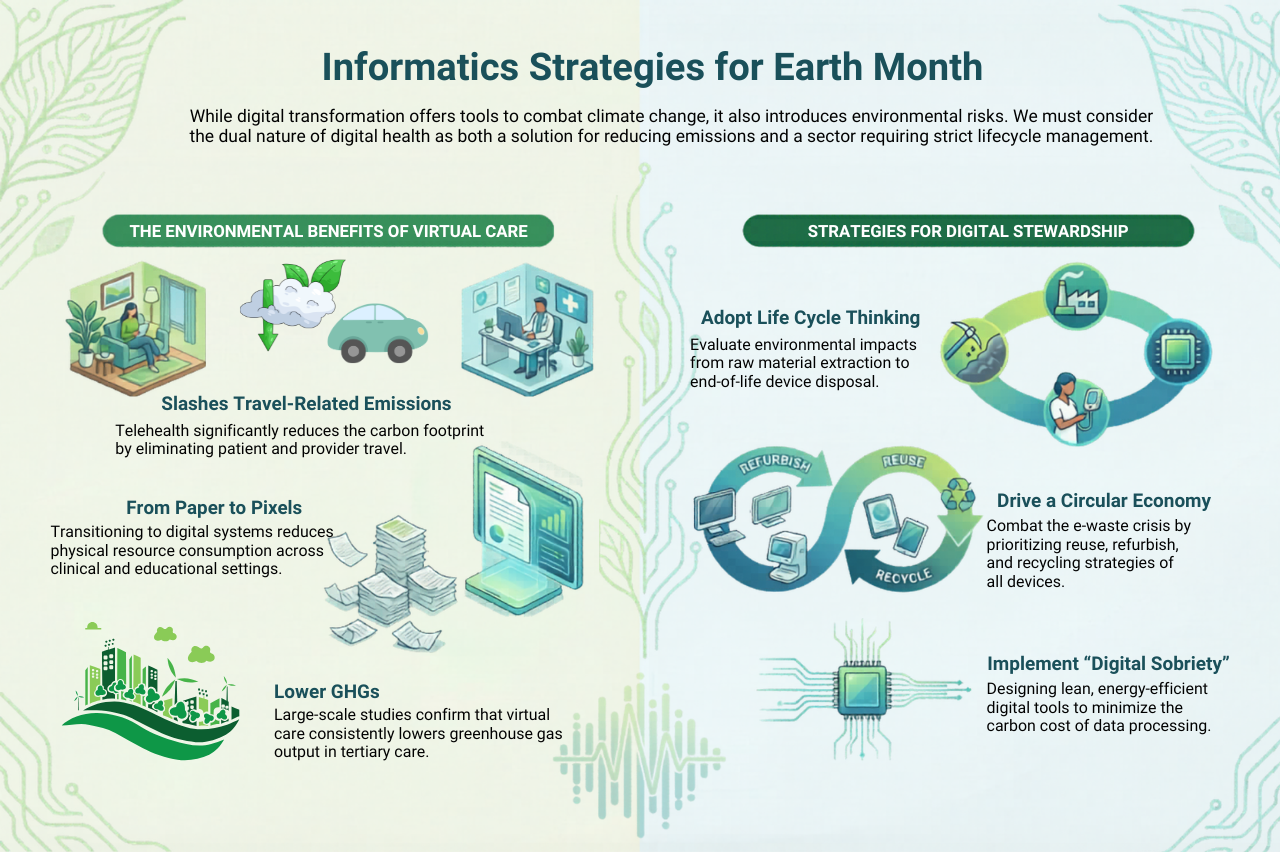
As people across the globe celebrate and honour Earth Month during April, there is a growing recognition that the digital tools intended to save lives in health care must also be designed to save the planet. Globally, health care is responsible for approximately 5% of greenhouse gas (GHG) emissions, with the Canadian system accounting for roughly 4.6% (Cuppage, 2024; Lokmic-Tomkins et al., 2023; Samuel, 2024). While digital transformation is often viewed as a pathway to decarbonization, it carries its own environmental perils, including soaring e-waste, vast amounts of water needed for AI cooling, and the energy demands of massive data storage (Samuel, 2024).
To address these challenges, informatics leaders are adopting Clinical Climate Informatics, a field that applies data and knowledge management principles to operationalize planetary health within health care systems (Samuel, 2024).
Here are five informatics-driven strategies to advance sustainability this Earth Month.
Creating a Circular Economy for Health IT
Traditional health IT procurement follows a linear “take-make-waste” model, where hardware is often discarded every two to four years. Planned obsolescence has become so engrained that it seems normal to discard devices and hardware on a regular basis, often when the device is still very usable to be replaced by a newer slightly different version (Kaminski, 2023). A sustainable informatics strategy shifts toward a circular economy focused on the “5 R’s”: Reduce, Reuse, Refurbish, Repurpose, and Recycle (Bressanelli et al, 2022; Global Alliance on Circular Economy and Resource Efficiency, 2025; Government Digital Sustainability Alliance, 2025; Han et al, 2023; Hoveling et al, 2024).
Lengthening Lifecycles: Organizations can reduce their footprint by extending device replacement cycles to four to six years.
Right to Repair: Informatics departments should advocate for modular designs and the “right to repair,” allowing for internal component upgrades (like adding RAM) rather than full device replacement.
Green Procurement: Contracting with vendors that offer take-back programs ensures that old equipment is responsibly refurbished or recycled rather than sent to landfills.
Optimizing Energy-Intensive Infrastructure
The energy required to process healthcare data, which accounts for nearly 30% of the world’s total data is a significant driver of emissions (Daniel-Watanabe et al, 2024).
Green Cloud Computing: Transitioning from locally hosted servers to shared cloud resources can deliver substantial savings on electricity and cooling (Ueda et al, 2024).
Algorithmic Efficiency: AI implementation must be balanced against its carbon cost. For instance, training a large AI model can produce over 550 tonnes of CO2e. Informatics teams should prioritize lightweight models for routine tasks and optimize algorithms to reduce computational complexity (Onuh, 2025).
Facility Automation: By integrating EHR data (like clinic schedules) with building management software, systems can automatically power down lighting and HVAC in facility areas not in use.
Nudging Sustainable Clinical Decisions
Electronic Health Records (EHRs) can be utilized as a “nudge” tool to influence clinician behaviour at the point of care (Lokmic-Tomkins et al., 2023; Samuel, 2024).
CO2e Visualization: EHRs can display the real-time carbon impact of specific choices, such as anesthetic gases (e.g., desflurane vs. sevoflurane) or medication types.
Reducing Redundancy: Improving system interoperability helps identify and eliminate duplicate diagnostic tests, saving the energy and materials associated with unnecessary procedures.
Prescription Nudges: Decision support tools can encourage the use of dry powder inhalers over metered-dose inhalers, which have a significantly higher climate footprint.
Decarbonizing Care Delivery via Telehealth
Virtual care including telehealth is one of the most effective tools for reducing healthcare’s environmental impact, primarily by eliminating patient travel which has become the single largest source of emissions for standard visits (Rahmany, 2025; Kalogeropoulos & Barach, 2023).
Massive Emission Reductions: A Life Cycle Assessment found that a virtual visit produces 0.41 kgCO2e, compared to 9.77 kgCO2e for an in-person visit which is a reduction of over 95% (Savoldelli et al., 2025).
Sustainable Configurations: To maximize these gains, informatics strategies should favour low-power device connections over high-intensity telehealth facility setups.
Prioritizing Equity and Energy Sovereignty
A sustainable digital strategy must bridge the digital divide to ensure that climate-resilient innovations reach the most vulnerable populations (Cuppage, 2024; Lokmic-Tomkins et al., 2023).
Indigenous Leadership: Indigenous communities are leading climate action by leveraging informatics to strengthen energy sovereignty. This includes using AI-based forecasting for solar microgrids to reduce reliance on diesel fuel (Electricity Human Resources Canada, 2025).
Inclusive Design: To prevent widening health inequities, digital health tools must be designed for low digital literacy and be accessible to those in remote or under-resourced settings (Goienetxea et al., 2024).
By moving beyond simple “efficiency” and embedding these planetary health principles into the digital backbone of health care, informatics can transform healthcare from a major polluter into a leader in environmental stewardship.
References
Bressanelli, G., Adrodegari, F., Pigosso, D. C. A., & Parida, V. (2022). Circular Economy in the Digital Age. Sustainability, 14(9), 5565. https://doi.org/10.3390/su14095565
Cuppage, J. (2024). Digital Health and Sustainability: Opportunities and Challenges. University of Toronto. https://climatehealth.utoronto.ca/wp-content/uploads/2024/11/Symposium-Poster-1-Jessica-Cuppage.pdf
Daniel-Watanabe, L., Moore, R., Tongue, B., & Royston, S. (2024). What is the Carbon Footprint of Digital Healthcare? UK Energy Research Centre. https://d2e1qxpsswcpgz.cloudfront.net/uploads/2024/03/UKERC_EnergySHINES_What-is-the-Carbon-Footprint-of-Digital-Healthcare.pdf
Electricity Human Resources Canada. (2025). Powering intelligence: AI-driven change in Canada’s electricity workforce. https://ehrc.ca/wp-content/uploads/2025/11/EHRC-Powering_Intelligence-2025.pdf
Global Alliance on Circular Economy and Resource Efficiency. (2025). Circular Economy and Digitalization – Working Paper. https://www.unido.org/sites/default/files/unido-publications/2025-06/Circular%20Economy%20and%20Digitalization.pdf
Goienetxea, A., Karlsen, A., Alfredsen Larsen, A., Melseth, S. O. & Sørbø, M. F. (2024) Enhancing health literacy through sustainable digital healthcare solutions: System development and usage perspectives. In Hole T., Kvangarsnes M., Landstad B. J., Bårdsgjerde E. K. and Tippett-Spirtou S. E. (Eds.), Towards sustainable good health and well-being: The role of health literacy (1st ed.). Springer Nature. pp 97–116. https://doi.org/10.1007/978-3-031-61810-9
Government Digital Sustainability Alliance. (2025). Overcoming barriers to drive the circular economy in digital technologies. Recommendations from the Government Digital Sustainability Alliance Circular Economy Working Group. https://assets.publishing.service.gov.uk/media/684aa1f81c8d5c94e201ab63/Barriers_to_Circularity_Recommendations_Paper.pdf
Han, Y., Shevchenko, T., Yannou, B., Ranjbari, M., Shams Esfandabadi, Z., Saidani, M., Bouillass, G., Bliumska-Danko, K., & Li, G. (2023). Exploring How Digital Technologies Enable a Circular Economy of Products. Sustainability, 15(3), 2067. https://doi.org/10.3390/su15032067
Hoveling, T., Svindland Nijdam, A., Monincx, M., Faludi, J., & Bakker, C. (2024). Circular economy for medical devices: Barriers, opportunities and best practices from a design perspective. Resources, Conservation & Recycling, 208. https://doi.org/10.1016/j.resconrec.2024.107719
Kalogeropoulos, D. & Barach, P. (2023). The role of telehealth in enabling sustainable innovation and circular economies in health. Telehealth and Medicine Today, 8, 409 – http://dx.doi.org/10.30953/tmt.v8.409
Kaminski, J. (2023). Editorial. Reducing the environmental impacts of using technologies. Canadian Journal of Nursing Informatics, 18(1). https://cjni.net/journal/?p=10851
Lokmic-Tomkins, Z., Borda, A., & Humphrey, K. (2023). Designing digital health applications for climate change mitigation and adaptation. The Medical Journal of Australia, 218(3), 106–110. https://doi.org/10.5694/mja2.51826
Onuh, G. (2025, May 21). Responsible innovation: How technology practitioners can drive environmental stewardship. World Economic Forum. https://www.weforum.org/stories/2025/05/rhow-technology-practitioners-can-drive-environmental-stewardship/
Rahmany, M. (2025) Green telehealth: A sustainability-driven framework for low-carbon digital health systems. Journal of Human Resource and Sustainability Studies, 13, 555-578. doi: 10.4236/jhrss.2025.134027.
Samuel, G. (2024). Principles & Priorities for Environmentally Sustainable Digital Health in Cardiology: Workshop Report. Transform HF. https://transformhf.ca/wp-content/uploads/2024/08/Priorities-and-Principles-of-Sustainable-Digital-Health-in-Cardiology_Full-Report-FINAL.pdf
Ueda, D., Walston, S. L., Fujita, S., Fushimi, Y., Tsuboyama, T., Kamagata, K., Yamada, A., Yanagawa, M., Ito, R., Fujima, N., Kawamura, M., Nakaura, T., Matsui, Y., Tatsugami, F., Fujioka, T., Nozaki, T., Hirata, K., & Naganawa, S. (2024). Climate change and artificial intelligence in healthcare: Review and recommendations towards a sustainable future. Diagnostic and Interventional Imaging, 105(11), 453–459. https://doi.org/10.1016/j.diii.2024.06.002


Recent articles
- Index of volume 21 number 221 Jun 2026
- What does Canada’s new National Artificial Intelligence Strategy mean for healthcare?21 Jun 2026
- UN SDGs and Open Source Principles as Outcomes and Implementation Approach to Health Informatics21 Jun 2026
- Designing Compassionate Systems: Why Nursing Must Lead in the Age of AI21 Jun 2026
- Advancing Nursing Informatics Through the Integration of Genomics: Addressing Barriers and Capacity Building in Canadian Healthcare21 Jun 2026