
UN SDGs and Open Source Principles as Outcomes and Implementation Approach to Health Informatics

by Raymund John Ang, MAN, RN
Nurse Developer Columnist
Project Lead, Open Nursing Information System Project
Citation: Ang, R. J. (2026). UN SDGs and open source principles as outcomes and implementation approach to health informatics. Nurse Developer Column. Canadian Journal of Nursing Informatics, 21(2). https://cjni.net/journal/?p=16749
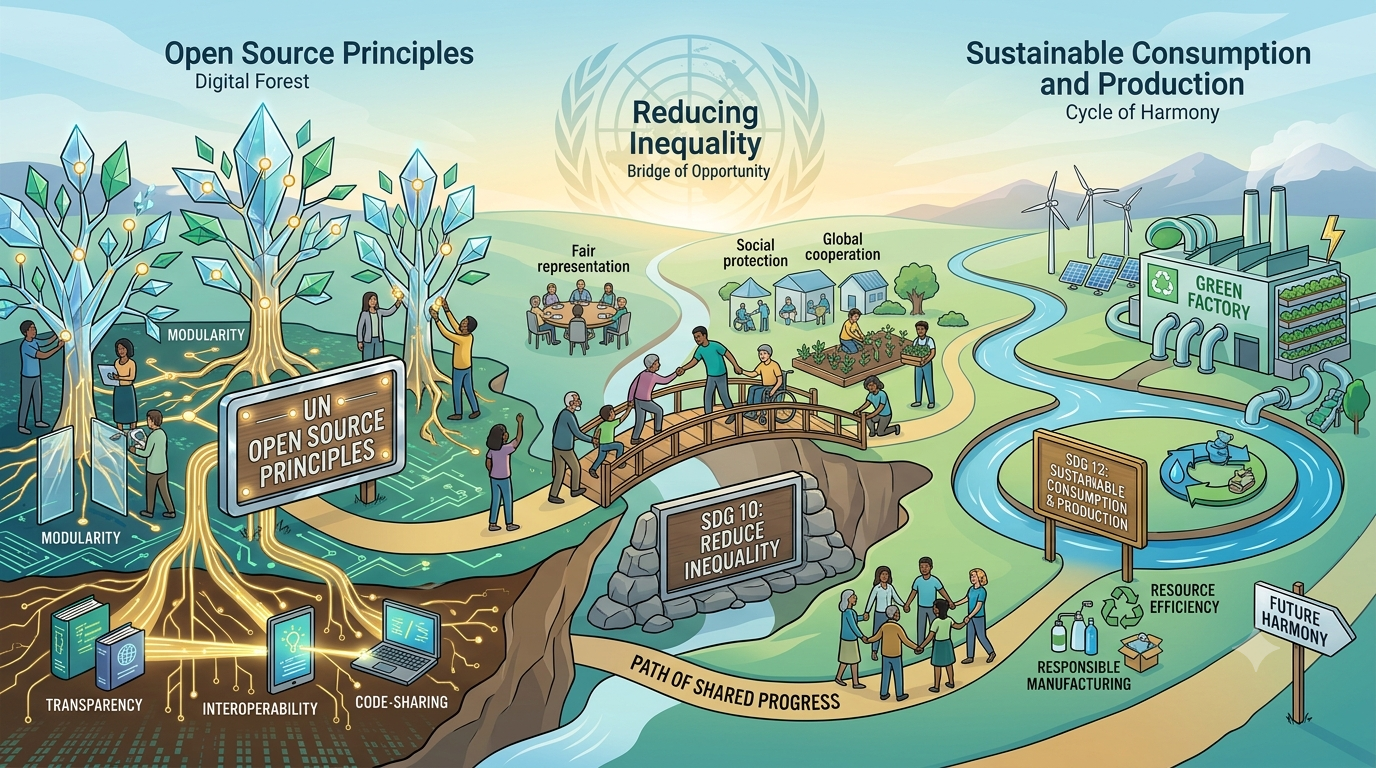
As a Nurse developer, I view digital health technologies not only as tools for improving patient care, but also as instruments for advancing global development goals. In this context, the United Nations (UN) Sustainable Development Goals (SDGs) (United Nations [UN], 2015) and the UN Open Source Principles (UN, 2026) provide a complementary framework for guiding health informatics projects. The SDGs represent the development outcomes that healthcare technologies should help achieve, while the UN Open Source Principles provide the implementation approach for building and sustaining those technologies. Together, they support the development of equitable, sustainable, and locally adaptable healthcare solutions, particularly in low-income countries.
Among the SDGs, Goal 10 (Reduced Inequalities) (UN, 2025a) and Goal 12 (Sustainable Consumption and Production) (UN, 2025b), contribute to broader sustainability objectives, and are especially relevant to healthcare technology. Healthcare inequalities remain a major challenge worldwide. Rural communities, underserved populations, and low-income countries often face limited access to healthcare services, trained professionals, and health information systems. Digital health applications can help address these disparities by extending access to healthcare information, telemedicine services, and clinical support tools regardless of geographic location. The United Nations recognizes reducing inequality within and among countries as a critical component of sustainable development (UN, 2025a).
From a Nursing perspective, reducing inequalities means ensuring that patients receive quality healthcare regardless of their socioeconomic status or location. Health informatics systems can improve access to care by enabling remote consultations, electronic health records, and mobile health applications. When aligned with SDG outcomes, these technologies contribute to more inclusive healthcare systems and improved health equity across populations.
Sustainability is another important development outcome. Many healthcare technology projects are launched through grants or donor funding but struggle to continue once financial support ends. Sustainable digital health systems require solutions that can be maintained, adapted, and expanded over time without imposing excessive costs on healthcare organizations. Long-term sustainability depends not only on technology, but also on local ownership, capacity building, and the efficient use of resources. According to the United Nations, sustainable development requires responsible use of resources and systems that can support present and future generations (UN, 2025b).
While the SDGs define these desired outcomes, achieving them requires an effective implementation approach. The UN Open Source Principles (UN, 2026) provide such a framework, particularly through the adoption of free and open source software (FOSS). FOSS allows software source code to be freely used, modified, and distributed. For healthcare organizations in low-income settings, this reduces dependence on expensive proprietary software licenses and vendor contracts. Instead of paying recurring fees, organizations can invest resources in training, infrastructure, and patient services.
FOSS also supports sustainability through local empowerment. Local developers can customize systems to meet specific cultural, clinical, and regulatory requirements. They can maintain and improve software without waiting for external vendors, creating stronger local technical capacity and reducing dependency on foreign technology providers. This approach aligns with the UN Open Source Principles by promoting reuse, adaptability, and community ownership of digital solutions (UN, 2026).
Another key advantage of FOSS is collaboration. Open source communities enable healthcare professionals, developers, and researchers from around the world to share knowledge and improve software collectively. Innovations developed in one country can be adapted and reused elsewhere, reducing duplication of effort and accelerating progress. The UN Open Source Principles emphasize collaboration, reuse, transparency, and community-driven innovation as mechanisms for creating sustainable digital solutions (UN, 2026).
The relationship between the SDGs and the UN Open Source Principles can, therefore, be understood as one of outcomes and implementation. The SDGs define what healthcare systems should achieve, including sustainability and reduced inequalities. The UN Open Source Principles, operationalized through FOSS, provides a practical, cost-effective, and collaborative method for building the digital infrastructure needed to achieve those goals. As a Nurse developer, I believe that this relationship is particularly important for low-income countries, where resource constraints require solutions that are both affordable and sustainable.
By treating the SDGs as development outcomes and the UN Open Source Principles as an implementation approach, healthcare organizations can align technology investments with global development priorities while fostering local ownership and innovation. This combination creates a pathway towards more equitable, sustainable, and accessible healthcare systems, ensuring that digital innovations remain available to the communities that need them most.
References
United Nations. (2026, Jan. 5). United Nations open source principles. https://opensource.un.org/en/news/united-nations-open-source-principles
United Nations. (2025a). Goal 10: Reduce inequality within and among countries. https://sdgs.un.org/goals/goal10
United Nations. (2025b). Goal 12: Ensure sustainable consumption and production patterns. https://sdgs.un.org/goals/goal12
United Nations. (2015). United Nations sustainable development goals. https://sdgs.un.org/goals


Recent articles
- Index of volume 21 number 221 Jun 2026
- What does Canada’s new National Artificial Intelligence Strategy mean for healthcare?21 Jun 2026
- UN SDGs and Open Source Principles as Outcomes and Implementation Approach to Health Informatics21 Jun 2026
- Designing Compassionate Systems: Why Nursing Must Lead in the Age of AI21 Jun 2026
- Advancing Nursing Informatics Through the Integration of Genomics: Addressing Barriers and Capacity Building in Canadian Healthcare21 Jun 2026