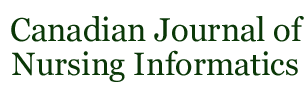
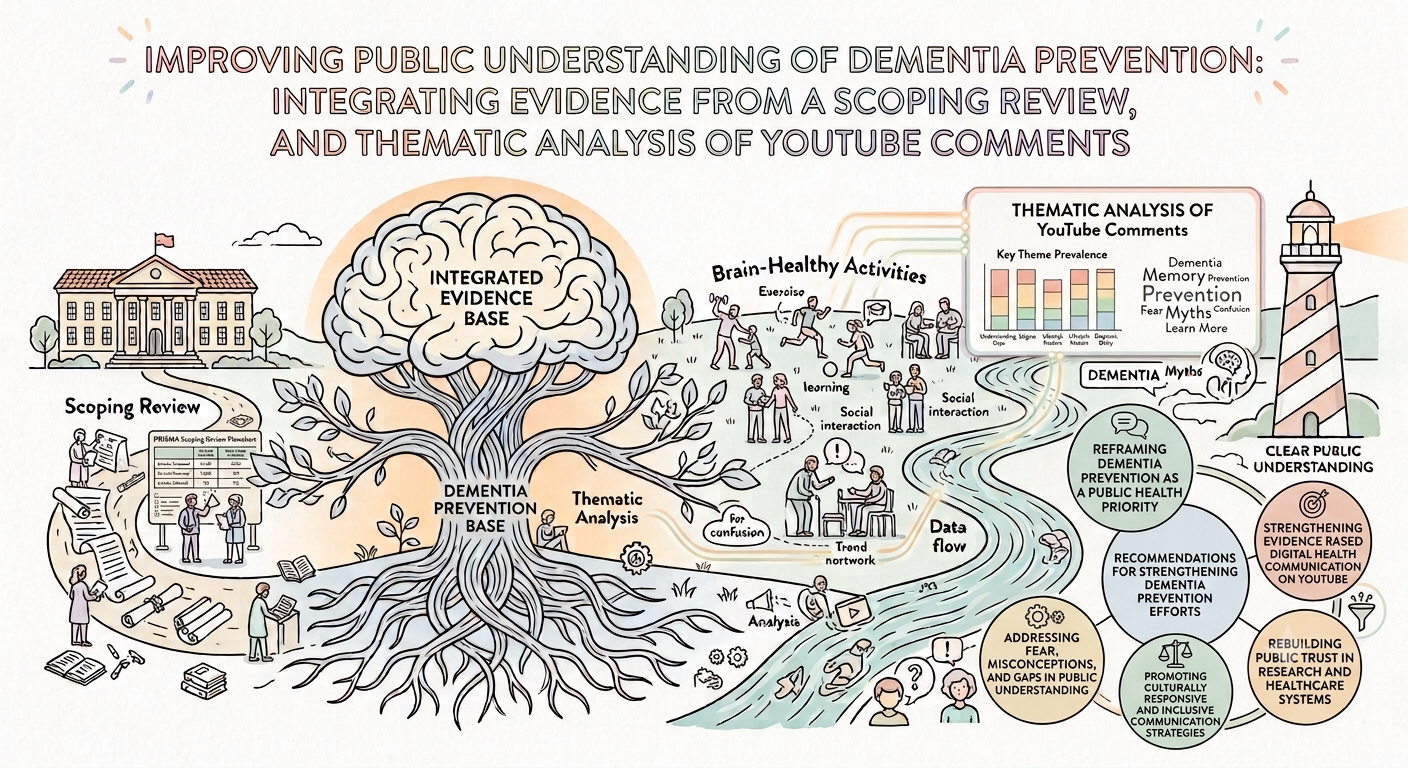
Improving Public Understanding of Dementia Prevention: Integrating Evidence from a Scoping Review, and Thematic Analysis of YouTube Comments

By Kulvir Moudgil, RN, BScN, MN
Master of Nursing, Thompson Rivers University
Kamloops, British Columbia
Anila Virani, PhD, RN, BScN, MN
Assistant Professor, School of Nursing
Juanita-Dawne Bacsu, PhD
Canada Research Chair, Assistant Professor, School of Nursing
Rani Srivastava, RN, PhD, FCAN, FTNSS
Dean, School of Nursing
Thompson Rivers University, Kamloops, British Columbia
Citation: Moudgil, K., Virani, A., Bacsu, J. D., & Srivastava, R. (2026). Improving public understanding of dementia prevention: Integrating evidence from a scoping review, and thematic analysis of YouTube comments. Canadian Journal of Nursing Informatics, 21(2). https://cjni.net/journal/?p=16762
Abstract
Background: Dementia prevention is increasingly recognized as a public health priority. However, there is a critical gap that persists between scientific evidence on modifiable risk factors and public understanding. Social media platforms such as YouTube play a critical role in digital health information dissemination, shaping public perceptions through emotionally driven content, varying information quality, and differing levels of trust in sources.
Aim: This paper aims to provide evidence-informed recommendations for improving public perceptions of dementia prevention within digital health environments.
Methods: Drawing on two studies including the scoping review of the literature and qualitative thematic analysis of YouTube comments, this study identifies key gaps in public understanding and proposes strategic directions for enhancing digital health communication.
Findings: Five strategic priorities were identified: (i) reframing dementia prevention as a public health priority; (ii) strengthening evidence-based digital health communication on YouTube; (iii) addressing fear, misconceptions, and gaps in public understanding; (iv) rebuilding public trust in research and healthcare systems; and (v) promoting culturally responsive and inclusive communication strategies. These findings demonstrate that public perceptions are shaped by the interaction of information quality, emotional engagement, and sociocultural context within digital platforms.
Conclusion: Improving dementia prevention requires more than increasing awareness. It necessitates optimizing how health information is communicated, interpreted, and trusted within digital ecosystems. Strengthening transparent, culturally relevant, and evidence-based communication on platforms such as YouTube is essential for improving dementia literacy and supporting population-level prevention efforts.
Keywords: Dementia prevention; YouTube; digital health; health informatics; social media; health communication; dementia literacy
Background
Dementia continues to represent a significant and growing global public health challenge, with increasing prevalence driven by population aging and extended life expectancy (Livingston et al., 2024; Song et al., 2022; Nagel et al., 2021). Livingston et al. (2024) explained that dementia risk is shaped across the life course rather than only in older age. The 2024 Lancet Commission estimated that approximately 45% of dementia cases may be preventable or delayed through attention to 14 potentially modifiable risk factors operating from early life to later life. These include lower education in early life; hearing loss, high LDL cholesterol, depression, traumatic brain injury, physical inactivity, diabetes, smoking, hypertension, obesity, and excess alcohol use in midlife; and social isolation, untreated vision loss, and air pollution in later life (Livingston et al., 2024). This life-course framing positions dementia prevention as a long-term public health priority that extends beyond individual behaviours to include broader social and structural determinants, such as access to education, healthy environments, and preventive healthcare (Livingston et al., 2024).
Despite advances in research demonstrating that dementia risk is attributable to modifiable factors, public understanding of dementia prevention remains limited (Maust et al., 2020; Livingston et al., 2024; Song et al., 2022). The disconnect between scientific evidence and public perceptions represents a critical barrier to effective prevention efforts. The literature indicates that many individuals continue to perceive dementia as an inevitable consequence of aging, with limited awareness of prevention opportunities and modifiable risk factors (Song et al., 2022; Livingston et al., 2024; Yang et al., 2022).
Digital platforms now play a major role in how health information is accessed, interpreted, and shared (Gottfried & Park, 2025; Yang et al., 2022). Social media platforms, particularly YouTube, play a central role in shaping public understanding of dementia prevention. As an interactive platform, YouTube facilitates both information dissemination and public discourse, where beliefs, experiences, and misconceptions are shared and reinforced (Yang et al., 2022; Basch et al., 2020). YouTube remains one of the most widely used online platforms where 84% of adults report using YouTube frequently, with approximately half accessing it daily (Gottfried & Park, 2025). However, digital health information environments are highly variable in quality.
A systematic review found that YouTube is not a consistently reliable source of health-related information, and exposure to poor-quality or misleading content can influence health decisions and behaviours (Osman et al., 2022). The variability in content quality, the presence of misinformation, and inconsistent framing of prevention contribute to fragmented knowledge and persistent stigma. Public perceptions are influenced by fear, personal experiences, cultural beliefs, and trust in information sources. These findings align with existing literature suggesting that health behaviours are shaped not only by knowledge, but also by perceived susceptibility, perceived benefits, and trust in healthcare systems (Rosenstock, 1974; Maust et al., 2020). YouTube functions both as a source of dementia literacy and as a space where misconceptions, distrust, and emotionally driven interpretations are reinforced (Ataoglu, & Batur, 2024; Efthymiou, 2024). This highlights the importance of digital platforms not only for their reach, but also for their influence on beliefs, perceptions of risk, and subsequent health behaviours. Therefore, there is a pressing need to translate these insights into evidence-informed strategies that strengthen dementia prevention efforts and improve digital health communication (Efthymiou, 2024; Lord et al., 2019).
There is increasing global recognition that dementia prevention is both possible and needed. However, many individuals continue to believe that dementia is an inevitable part of aging, and misinformation remains prevalent in online environments (Osman et al., 2022; Song et al., 2022). This misconception contributes to a sense where individuals perceive limited control over their risk and are less likely to engage in preventive behaviours such as physical activity, cardiovascular health management, sleep optimization, and social engagement. Instead, prevention may be viewed as irrelevant or ineffective (Song et al., 2022; Livingston et al., 2024).
At the same time, misinformation complicates public understanding by promoting simplified or unverified claims about dementia causes and prevention. Narratives that attribute dementia to a single factor or promote specific diets, supplements, or treatments as definitive solutions can divert attention from evidence-based strategies (Livingston et al., 2024; Maust et al., 2020). Exposure to conflicting information may also lead to confusion, skepticism, and disengagement from prevention efforts (Šestáková & Plichtová, 2020). These factors create a reinforcing cycle in which myths and beliefs reduce motivation to seek accurate information, while misinformation strengthens misunderstanding and erodes trust in credible sources. This limits the adoption and sustainability of protective behaviours at both individual and population levels.
The purpose of this paper is to integrate findings from a series of related studies conducted by the authors, each examining different aspects of public understanding and communication of dementia prevention. Moving beyond individual study findings, this paper synthesizes insights across multiple evidence sources to develop recommendations for improving public health communication, education, and policy.
Overview of the Two Foundational Studies
To provide a comprehensive understanding of public perceptions of dementia prevention, this paper draws on two complementary studies including a scoping review of existing literature and a qualitative thematic analysis of YouTube comments related to dementia. These studies offer a broad overview of current evidence and an in-depth exploration of how individuals interpret and engage with dementia prevention information in real-world digital contexts.
Study One
The first study employed a scoping review methodology to examine how scholarly literature had explored public perceptions of dementia prevention on YouTube and to map the breadth of available evidence in this area. Guided by Arksey and O’Malley’s framework and reported in accordance with PRISMA-ScR guidelines, the review systematically searched six electronic databases for peer-reviewed articles published between 2015 and 2025 (Arksey & O’Malley, 2005). Following a rigorous screening process, 14 studies were included for analysis. Data were extracted using a structured approach and analyzed inductively to identify recurring patterns across the literature.
The findings of the scoping review revealed four overarching themes: (i) prevalent beliefs surrounding dementia prevention on YouTube; (ii) public use of YouTube as a source of dementia-related information; (iii) researchers’ use of YouTube as a dementia literacy platform, and (iv) the importance of culturally and linguistically tailored messaging. Across these studies, misconceptions, knowledge gaps, and barriers related to dementia were identified. A persistent misconception was the belief that dementia is an inevitable and untreatable part of aging, which contributes to stigma and reduces motivation for engaging in preventive behaviours (Livingston et al., 2025; Song et al., 2022). Dementia prevention was often framed narrowly as an individual responsibility, focusing on lifestyle changes while overlooking broader social and structural determinants of health (Song et al., 2022; Walsh et al., 2025). Knowledge gaps were evident regarding modifiable risk factors and actionable prevention strategies. Although general awareness of dementia exists, understanding of how to reduce risk remains fragmented and superficial (Livingston et al., 2024).
The content available on YouTube emphasized symptoms, diagnosis, and caregiving rather than prevention, limiting opportunities to promote early intervention and risk reduction (Osman et al., 2022; Efthymiou, 2025). Furthermore, public knowledge appeared to be shaped more by the relatability and popularity of content than by its scientific accuracy (Osman et al., 2022). These barriers hindered effective communication, including misinformation, inconsistent content quality, limited access to culturally appropriate resources, and persistent stigma (Osman et al., 2022; Efthymiou, 2025). These findings highlighted a disconnect between scientific evidence and public understanding, underscoring the need for more accessible, accurate, and culturally responsive communication strategies.
Study Two
The second study built on these insights by examining how dementia prevention is discussed and understood by the public in digital spaces. Using a qualitative thematic analysis approach guided by Braun and Clarke’s framework (2006), the study analyzed user-generated comments on YouTube videos related to dementia prevention. A total of 26 eligible videos were identified, yielding 7,314 comments, which were systematically cleaned and refined to 2,034 comments for final analysis. Engagement metrics, including views, likes, and replies, were also analyzed to provide additional context regarding audience interaction. Rigour was ensured through the development of a codebook, intercoder reliability (? = 0.88), and the use of audit trails and reflexive practices.
The thematic analysis revealed three overarching themes: (i) fear and perceived vulnerability to dementia; (ii) perceptions of dementia risk factors; and (iii) trust and credibility of dementia prevention information. These findings were similar to the barriers, misconceptions, and knowledge gaps identified in the scoping review. A prominent misconception was the belief that dementia is inevitable, which reduced motivation to engage in preventive behaviours (Livingston et al., 2024). Many individuals also misinterpreted the role of genetics, often viewing dementia as predetermined while underestimating the impact of modifiable risk factors (Livingston et al., 2024; Song et al., 2022). Moreover, misinformation was widespread, including unverified claims linking dementia to specific diets, medications, or singular causes. Knowledge gaps were evident in the public’s limited and inconsistent understanding of dementia prevention. Although some awareness of lifestyle-related factors such as diet, exercise, and sleep was present, this knowledge was often fragmented and lacked scientific grounding (Livingston et al., 2024). There was confusion between modifiable and non-modifiable risk factors, and individuals frequently struggled to reconcile why dementia may occur despite healthy behaviours. Complex scientific concepts were often discussed but misunderstood, further highlighting the challenges of translating research evidence into accessible public knowledge.
The thematic analysis also highlighted barriers to effective dementia prevention. Fear and emotional distress played a central role, acting both as a motivator for seeking information and as a barrier that led to anxiety and disengagement. Distrust in research, pharmaceutical industries, and healthcare systems further limited acceptance of evidence-based information. Stigma surrounding dementia discouraged open discussion and help-seeking, while difficulties in identifying credible sources contributed to confusion (Livingston et al., 2024; Osman et al., 2022). Overall, these findings demonstrated that YouTube functions as both a source of health information and a space where misconceptions and mistrust can be reinforced (Osman et al., 2022).
Integrated Synthesis of Findings
The two studies revealed a consistent and important pattern related to public understanding of dementia prevention that it was shaped by a complex interplay of knowledge, emotion, personal experience, and digital information environments. Both studies highlighted the need for clearer communication about dementia prevention, improved understanding of modifiable risk factors, and more trustworthy and culturally sensitive messaging.
The findings demonstrated that public engagement with dementia prevention is not limited by lack of information alone, but by how that information was presented, interpreted, and trusted. Online platforms such as YouTube served as major sources of informal health learning; however, they also posed risks when content was incomplete, misleading, or emotionally driven (Osman et al., 2022; Efthymiou, 2025). The integration of findings highlighted a critical disconnect between scientific evidence and public understanding, where individuals actively engaged with information but often develop fragmented or inaccurate interpretations.
Fear emerged as a central theme across both studies, functioning as both a driver of engagement and a barrier to effective prevention. While it encouraged information-seeking, it reinforced anxiety, particularly when combined with misinformation. Similarly, confusion regarding modifiable and non-modifiable risk factors limited individuals’ ability to translate knowledge into action (Livingston et al., 2024). Distrust in research and healthcare systems compounded these challenges, reducing the likelihood of adopting evidence-based preventive behaviours.
Building on these insights, these findings suggested that improving dementia prevention requires more than increasing awareness. It requires aligning scientific evidence with public understanding through integrated strategies that consider emotional, cultural, and structural influences on health behaviour (Song et al., 2022). Leveraging digital platforms responsibly, strengthening dementia literacy, and fostering trust through transparent and inclusive communication are essential steps toward improving population-level outcomes (Osman et al., 2022).
Recommendations for Strengthening Dementia Prevention Efforts
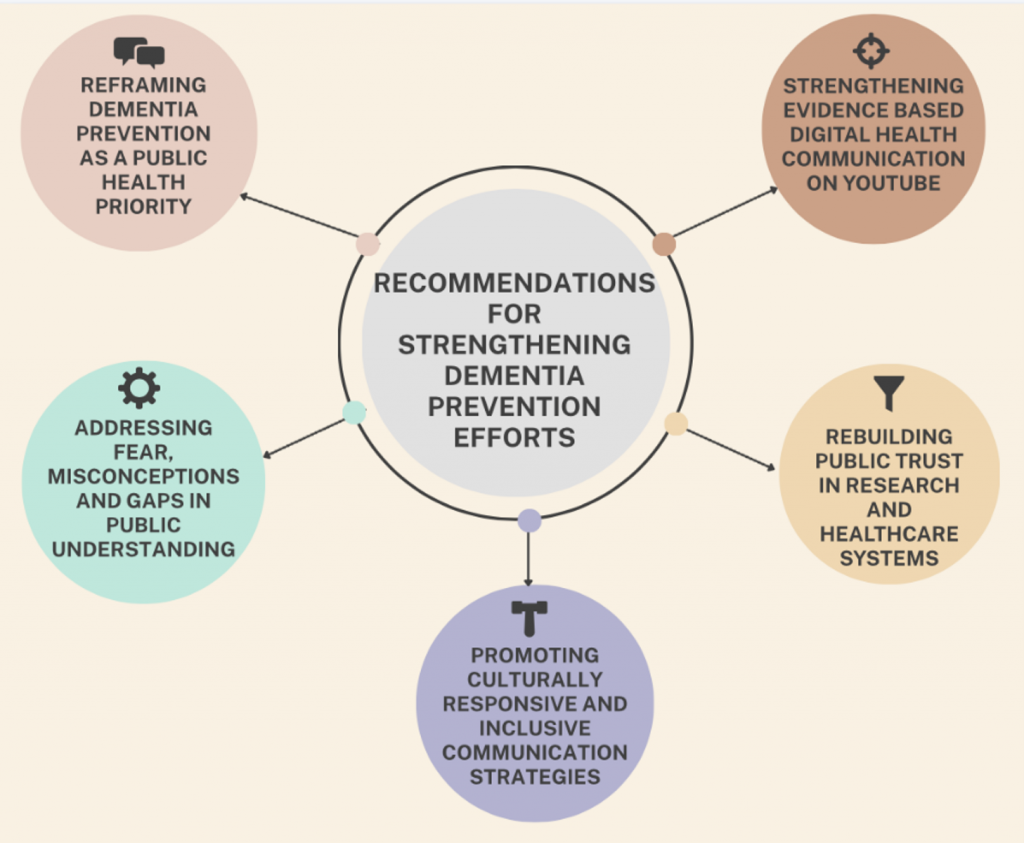
Five strategies were identified to improve dementia prevention communication: (i) reframing dementia prevention as a public health priority; (ii) strengthening evidence based digital health communication on YouTube; (iii) addressing fear, misconceptions, and gaps in public understanding; (iv) rebuilding public trust in research and healthcare systems; and (v) promoting culturally responsive and inclusive communication strategies. Figure 7 illustrates the recommendations for strengthening dementia prevention efforts.
Figure 7
Recommendations
Reframing Dementia Prevention as a Public Health Priority
Dementia prevention is frequently framed as an individual responsibility, particularly through lifestyle behaviours such as diet, exercise, and cognitive activity (Rakesh et al., 2017). While these factors are important, this narrow framing risks reinforcing blame-oriented perspectives and may discourage engagement among individuals facing systemic barriers (Rakesh et al., 2017; Livingston et al., 2024) Consistent with previous research, YouTube content often emphasizes personal control while neglecting structural and environmental influences on health(Šestáková & Plichtová, 2020). A comprehensive approach to dementia prevention requires integration of population level strategies, including public education, policy development, and community-based interventions. Addressing dementia prevention through a public health lens is essential to reducing inequities and ensuring that prevention efforts are accessible, inclusive, and sustainable.
Strengthening evidence-based Digital Health Communication on YouTube
YouTube is a major source of dementia related information, shaping public understanding and engagement (Lam et al., 2020; Tang et al., 2017). However, the literature also highlights that high engagement does not necessarily reflect accurate or evidence-based information (Lam et al., 2020; Tang et al., 2017; Alba et al., 2025). Previous studies have shown that videos produced by healthcare professionals and academic institutions tend to be more reliable, yet they are not always the most widely viewed (Alba et al., 2025; Ataoglu & Batur, 2024). This creates a gap where highly engaging content may not align with scientific evidence. Improving dementia prevention communication requires prioritizing clear, accessible, and actionable messaging. Content should move beyond general awareness and provide practical strategies that individuals can apply in their daily lives. In addition, collaboration between researchers, healthcare professionals, and content creators is necessary to ensure that accurate information reaches diverse audiences in engaging and meaningful ways.
Addressing Fear, Misconceptions, and Gaps in Public Understanding
Fear influences how individuals engage with dementia related content. While fear can motivate information seeking behaviour, it can also increase susceptibility to misinformation and unverified prevention strategies. Existing literature suggests that emotional responses, particularly fear and anxiety, play a central role in shaping health behaviours
(Molden & Maxfield, 2017). Moreover, misconceptions about dementia such as the belief that it is an inevitable part of aging, continue to persist despite growing scientific evidence on modifiable risk factors (Song et al., 2022; Cations et al., 2018). Public health messaging should aim to reduce fear-based narratives and promote a balanced understanding of risk, emphasizing both modifiable and non-modifiable factors. Supporting individuals in interpreting health information critically is essential to improving dementia literacy.
Rebuilding Public Trust in Research and Healthcare Systems
Distrust in research and healthcare systems is another barrier to uptake of evidence-based information related to dementia prevention. The credibility of scientific evidence is often associated with financial or institutional bias. Prior research demonstrated that public trust plays a critical role in the acceptance of health information and engagement in preventive behaviours (Skinner et al., 2018). When trust is compromised, individuals may rely on alternative sources of information, including unverified content. Rebuilding trust requires transparent communication, consistent messaging, and meaningful engagement with communities. Involving the public in discussions around dementia prevention and acknowledging uncertainties in research may help strengthen credibility and improve uptake of evidence-based information (Lord et al., 2019).
Promoting Culturally Responsive and Inclusive communication strategies
Cultural beliefs and social contexts also influence perceptions of dementia prevention. Dementia is often normalized as part of aging or associated with stigma, particularly within diverse cultural communities (Lam et al., 2020). Previous studies highlighted the importance of culturally tailored health communication in improving knowledge and engagement (Lam et al., 2020;
Park et al., 2025).Culturally and linguistically appropriate interventions have been shown to enhance understanding and reduce stigma associated with dementia (Park et al., 2025). Public health strategies should incorporate culturally relevant messaging, community leadership, and representation of diverse experiences. Addressing stigma and promoting inclusive narratives can enhance understanding and support meaningful engagement in dementia prevention.
Implications for Future Research
The findings of two studies highlighted both the opportunities and limitations of current dementia prevention efforts, particularly within digital environments such as YouTube. At present, dementia prevention strategies are largely centered on increasing awareness of modifiable risk factors, including physical activity, healthy diet, cardiovascular risk management, cognitive engagement, and social connection (Livingston et al., 2024). Public health organizations, research institutions, and healthcare providers have developed guidelines, reports, and educational materials aimed at promoting these behaviours; however, much of this information remains in static, text-based formats, which may not effectively reach or engage the broader public (World Health Organization, 2025). In contrast, digital platforms such as YouTube are increasingly used for health information seeking influences public perceptions and behaviours (Yang et al., 2022; Osman et al., 2022).
Future efforts should prioritize the translation of existing evidence-based resources into accessible and engaging formats. For example, digitalized documents and guidelines on dementia prevention can be transformed into short, user-friendly videos using emerging tools such as artificial intelligence. AI-driven technologies have the potential to enhance scalability, improve accessibility across languages, and tailor health communication to diverse populations (Topol, 2019). Such approaches can help bridge the gap between scientific evidence and public understanding by aligning health messaging with contemporary patterns of media consumption (Yang et al., 2022; Osman et al., 2022).
Healthcare providers and organizations have a critical role to play in strengthening digital health communication. There is a need for increased production and dissemination of high-quality, evidence-based videos on dementia prevention (Yang et al., 2022). Comment sections on interactive social media, e.g. YouTube, can function as interactive spaces where misconceptions are addressed, questions are clarified, and trust is fostered through transparent communication. Studies have shown that social media functions not only as a source of information but also as a space where public discourse, including misinformation and skepticism, is actively negotiated (Yang et al., 2022).
Moreover, content format and storytelling influence engagement and knowledge uptake. Evidence indicates that videos incorporating lived experiences and narrative-based communication may enhance relatability, reduce stigma, and improve audience engagement compared to purely informational content (Green, 2006). This suggests that healthcare providers should consider integrating personal narratives and emotional elements into educational videos to complement scientific information and improve the effectiveness of dementia prevention messaging (Green, 2006; Efthymiou, 2025).
Improving dementia prevention communication requires the involvement of multiple stakeholders, including researchers, healthcare providers, digital platform developers, policymakers, and the general public. Platform developers can contribute by promoting credible health information and mitigating the spread of misinformation through algorithm design and content moderation strategies (Osman et al., 2022; Green, 2006). Researchers should continue to evaluate how digital environments shape health beliefs and behaviours, while policymakers can support the development of guidelines for responsible digital health communication (Osman et al., 2022; Green, 2006; Efthymiou, 2025).
The general public also has a key role in improving the digital information ecosystem. Individuals can contribute by evaluating sources, engaging in constructive discussions, and sharing accurate, evidence-based information within their communities. Strengthening digital health literacy is essential to empower individuals to navigate complex online environments and make informed decisions about dementia prevention (World Health Organization, 2022).
Future dementia prevention efforts must move beyond awareness to developing interactive, trustworthy, and culturally responsive communication strategies. By leveraging digital platforms, integrating innovative technologies such as artificial intelligence, and engaging stakeholders across multiple levels, it is possible to enhance dementia literacy, reduce misconceptions, and support meaningful adoption of preventive behaviors at the population level (Livingstone et al., 2024; Yang et al., 2022; Osman et al., 2022).
Conclusion
This study demonstrates that dementia prevention extends beyond the simple dissemination of information and must be understood as a multifaceted process shaped by emotional responses, trust in information sources, and broader sociocultural contexts. Public perceptions of dementia prevention on YouTube reveal a dual reality while digital platforms have expanded access to health information, this information is not always interpreted accurately or translated into meaningful action. As a result, gaps persist between what is known in scientific literature and what is understood and applied by the public.
The findings of this research highlight that misconceptions, fragmented knowledge, and mistrust continue to limit the effectiveness of dementia prevention efforts. Emotional factors, particularly fear and perceived vulnerability, play a role in shaping engagement with information, influencing both motivation and avoidance behaviours. The widespread presence of misinformation and inconsistent messaging complicates public understanding, reinforcing confusion and reducing confidence in evidence-based guidance.
Addressing these challenges requires a fundamental shift in how dementia prevention is communicated. Moving forward, efforts must transition from passive information delivery toward proactive, evidence-based, and culturally responsive communication strategies that acknowledge the lived experiences and informational needs of diverse populations. Digital platforms such as YouTube should be leveraged not only as tools for information dissemination but also as spaces for meaningful engagement, dialogue, and trust-building.
Strengthening the quality, clarity, and accessibility of digital health content is essential to improving dementia literacy. Equally important is the need to actively address misconceptions, provide consistent and actionable messaging, and foster trust through transparency and community engagement. By aligning scientific evidence with public understanding and leveraging digital platforms responsibly, there is an opportunity to support informed decision-making and promote the adoption of preventive behaviours at the population level.
In conclusion, improving dementia prevention requires collaborative efforts across researchers, healthcare providers, policymakers, digital platform developers, and the public. Through integrated and inclusive approaches, it is possible to bridge the gap between evidence and practice, enhance public understanding, and contribute to reducing the future burden of dementia.
References
Alba, L. C. O., Anlacan, V. M. M., Navarra, C. J. A., & Jamora, R. D. G. (2025). YouTube as an educational resource: Evaluating the quality and reliability of videos for family caregivers of persons living with Alzheimer’s disease dementia. Journal of Alzheimer’s Disease Reports, 9, 25424823251368887. https://doi.org/10.1177/25424823251368887
Arksey, H., & O’Malley, L. (2005). Scoping studies: Towards a methodological framework. International Journal of Social Research Methodology, 8(1), 19–32. https://doi.org/10.1080/1364557032000119616
Ataoglu, E., & Batur, H. Z. (2024). Evaluation of YouTube videos as a source of information about dementia care. Duzce Medical Journal, 26(2), 161–166. https://doi.org/10.18678/dtfd.1496019
Basch, C. H., Hillyer, G. C., Meleo-Erwin, Z. C., Jaime, C., Mohlman, J., & Basch, C. E. (2020). Preventive behaviors conveyed on YouTube to mitigate transmission of COVID-19: Cross-sectional study. JMIR Public Health and Surveillance, 6(2), e18807. https://doi.org/10.2196/18807
Braun, V. and Clarke, V. (2006) Using thematic analysis in psychology. Qualitative Research in Psychology, 3 (2), 77-101. https://doi.org/10.1191/1478088706qp063oa
Cations, M., Radisic, G., Crotty, M., & Laver, K. E. (2018). What does the general public understand about prevention and treatment of dementia? A systematic review of population-based surveys. PLOS ONE, 13(4), e0196085. https://doi.org/10.1371/journal.pone.0196085
Chou, W. Y. S., Oh, A., & Klein, W. M. P. (2018). Addressing health-related misinformation on social media. JAMA, 320(23), 2417–2418. https://doi.org/10.1001/jama.2018.16865
Efthymiou E. (2025). Integrating digital and narrative medicine in modern healthcare: A systematic review. Medical Education Online, 30(1), 2475979. https://doi.org/10.1080/10872981.2025.2475979
Gottfried, J., & Park, E. (2025). Americans’ social media use 2025. Pew Research Center. https://www.pewresearch.org/internet/2025/11/20/americans-social-media-use-2025/
Green, M. C. (2006). Narratives and cancer communication. Journal of Communication, 56, S163–S183. https://onlinelibrary.wiley.com/doi/abs/10.1111/j.1460-2466.2006.00288.x
Lam, N. H. T., & Woo, B. K. P. (2020). YouTube as a new medium for dementia education among Chinese Americans. Community Mental Health Journal, 56(3), 435–439. https://doi.org/10.1007/s10597-019-00493-7
Livingston, G., Huntley, J., Liu, K. Y., Costafreda, S. G., Selbæk, G., Alladi, S., Ames, D., Banerjee, S., Burns, A., Brayne, C., Fox, N. C., Ferri, C. P., Gitlin, L. N., Howard, R., Kales, H. C., Kivimäki, M., Larson, E. B., Nakasujja, N., Rockwood, K., Samus, Q., Schneider, L.S., Teri, L. and Mukadam, N. (2024) Dementia prevention, intervention, and care: 2024 report of the Lancet Commission. The Lancet, 404(10452), 572–628. https://doi.org/10.1016/S0140-6736(24)00000-0
Lord, S. E., Seavey, K. M., Oren, S. D., Budney, A. J., & Marsch, L. A. (2019). Digital presence of a research center as a research dissemination platform: Reach and resources. JMIR Mental Health, 6(4), e11686. https://doi.org/10.2196/11686
Maust, D. T., Solway, E., Langa, K. M., Kullgren, J. T., Kirch, M., Singer, D. C., & Malani, P. (2020). Perception of dementia risk and preventive actions among US adults aged 50 to 64 years. JAMA Neurology, 77(2), 259–262. https://doi.org/10.1001/jamaneurol.2019.3946
Molden, J., & Maxfield, M. (2017). The impact of aging stereotypes on dementia worry. European Journal of Ageing, 14(1), 29–37. https://doi.org/10.1007/s10433-016-0378-z
Nagel, A. K., Loetscher, T., Smith, A. E., & Keage, H. A. D. (2021). What do the public really know about dementia and its risk factors? Dementia, 20(7), 2424–2440. https://doi.org/10.1177/1471301221997301
Osman, W., Mohamed, F., Elhassan, M., & Shoufan, A. (2022). Is YouTube a reliable source of health-related information? A systematic review. BMC Medical Education, 22, 382. https://doi.org/10.1186/s12909-022-03446-z
Park, V. T., Nam, B., Huang, D., Yun, S. W., Phan, N., & Lee, E. J., et al. (2025). Knowledge, attitudes, and behaviors related to dementia prevention among Korean Americans: Pre- and posttest evaluation study. JMIR Aging, 8, e72147. https://doi.org/10.2196/72147
Rakesh, G., Szabo, S. T., Alexopoulos, G. S., & Zannas, A. S. (2017). Strategies for dementia prevention: Latest evidence and implications. Therapeutic Advances in Chronic Disease, 8(8–9), 121–136. https://doi.org/10.1177/2040622317712442
Rosenstock, I. M. (1974). The health belief model and preventive health behavior. Health Education Monographs, 2(4), 354–386. https://journals.sagepub.com/doi/10.1177/109019817400200405
Šestáková, A., & Plichtová, J. (2020). More than a medical condition: Qualitative analysis of media representations of dementia and Alzheimer’s disease. Human Affairs, 30(3), 382–398. https://d-nb.info/1273102916/34
Skinner, J. S., Williams, N. A., Richmond, A., Brown, J., Strelnick, A. H., Calhoun, K., De Loney, E. H., Allen, S., Pirie, A., & Wilkins, C. H. (2018). Community experiences and perceptions of clinical and translational research and researchers. Progress in Community Health Partnerships, 12(3), 263–271. https://doi.org/10.1353/cpr.2018.0050
Song, D., Yu, D., & Sun, Q. (2022). Perceptions and knowledge of dementia prevention and its associated socio-demographic factors in China: A community-based cross-sectional study. Frontiers in Neuroscience, 16, 1093169. https://doi.org/10.3389/fnins.2022.1093169
Tang, W., Olscamp, K., Choi, S. K., & Friedman, D. B. (2017). Alzheimer’s disease in social media: Content analysis of YouTube videos. Interactive Journal of Medical Research, 6(2), e19. https://doi.org/10.2196/ijmr.8612
Topol, E. (2019). High-performance medicine: The convergence of human and artificial intelligence. Nature Medicine, 25, 44–56. https://doi.org/10.1038/s41591-018-0300-7
Walsh, S., Klee, M., Hui, E. K., Saeed, U., Waters, S., Kuhn, I., Siette, J., Orgeta, V., Stafford, J., Smith, L. J., Tamburin, S., Jensen, D. E. A., Mantovani, E., Chandra, A., James, S. N., Tang, E. Y. H., Llewellyn, D. J., Foote, I. F., Chiesa, S. T., Geraets, A. F. J., … DEMON SDOH International Research Group (2025). Social determinants of dementia: A scoping review. Alzheimer’s & Dementia: the Journal of the Alzheimer’s Association, 21(7), e70524. https://doi.org/10.1002/alz.70524
World Health Organization. (2025). Dementia: Key facts. https://www.who.int/news-room/fact-sheets/detail/dementia
Yang, S., Brossard, D., Scheufele, D. A., & Xenos, M. A. (2022). The science of YouTube: What factors influence user engagement with online science videos? PloS One, 17(5), e0267697. https://doi.org/10.1371/journal.pone.0267697
Author Bios
Kulvir Moudgil, RN, BScN, MN
Kulvir is a registered nurse at Royal Inland Hospital in Kamloops, British Columbia, and a Master of Nursing graduate student at Thompson Rivers University. Her academic and clinical interests focus on dementia prevention using technology and on enhancing public education and support related to cognitive health.
Anila Virani, PhD, RN, BScN, MN
Dr. Virani is a registered nurse with over 25 years of nursing experience. She is currently an Assistant Professor in the School of Nursing at Thompson Rivers University, Canada. Her scholarship focuses on health informatics, mHealth, stimulation-based learning, AI-enhanced education, and innovative teaching strategies to advance nursing education and practice.
Juanita-Dawne Bacsu, PhD
Dr. Bacsu is a Canada Research Chair, Assistant Professor in the School of Nursing, and the director or the Population Health and Aging Rural Research Centre at Thompson Rivers University. Her research focuses on dementia, stigma, and rural aging.
Rani Srivastava, RN, PhD, FCAN, FTNSS
Dr. Srivastava is currently the Dean of Nursing at Thompson Rivers University. She has over 45 years of nursing experience across practice and academia and is recognized as a fellow in the Canadian Academy of Nursing and the Transcultural Nursing Society Scholars.
Funding: The authors declare financial support was received for the research. This research was funded by the CIHR Canada Graduate Scholarship-Masters (CGS-M) and Thompson Rivers University. Grant # 1864890.
Institutional Review Board Statement: Not applicable.
Informed Consent Statement: Not applicable.
Data Availability Statement: The data is publicly available on YouTube.
Conflict of Interest: The authors declare that there is no conflict of interest to disclose.


Recent articles
- Index of volume 21 number 321 Sep 2026
- Cyber Security Awareness Month in the Age of AI21 Sep 2026
- Are we supporting the next generation of nurses to be AI proficient or AI dependent?21 Sep 2026
- Designing What AI Makes Possible in Healthcare21 Sep 2026
- Cybersecurity Threats to Hospital Information Systems: A Narrative Review of Risks, Patient-Safety Impacts, and Defensive Strategies with Implications for the United States21 Sep 2026